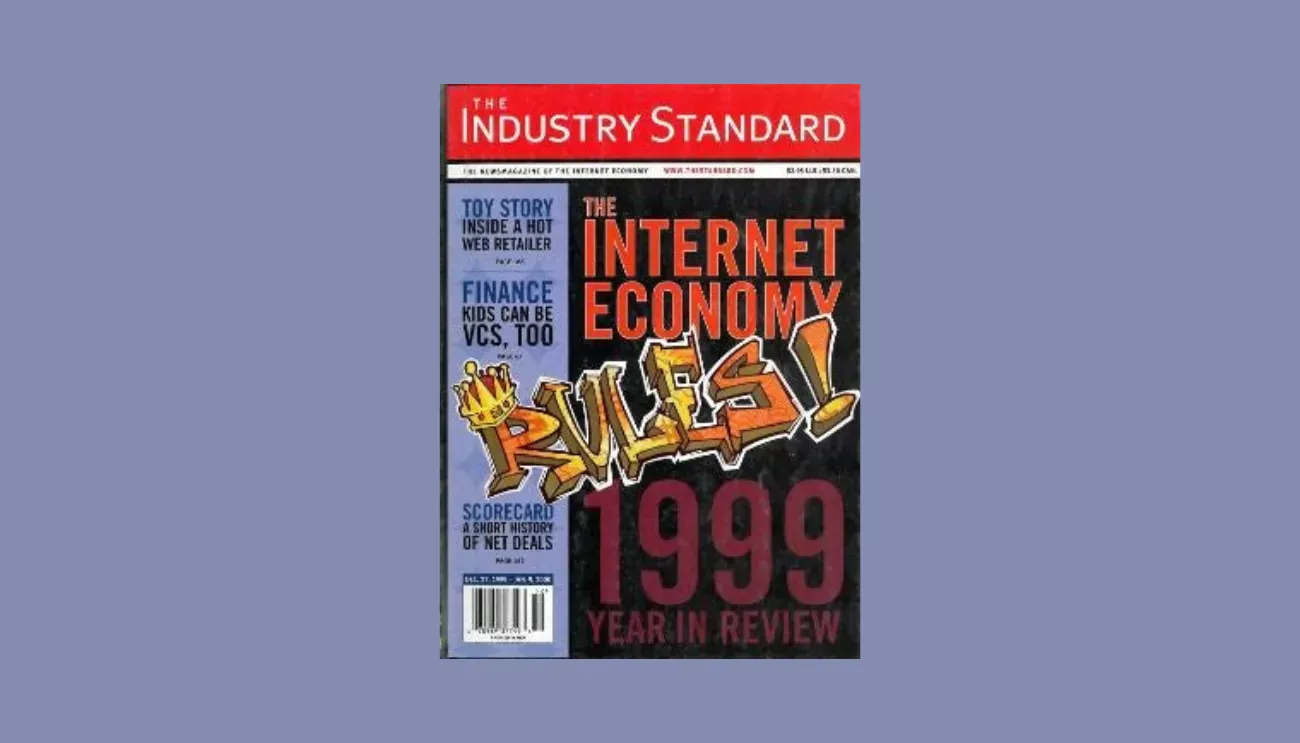
The Internet Economy Rules! - A look back at 1999 when times were good (so we thought)


It's December 1999 and the Internet Economy is changing EVERYTHING - or, at least it appeared that way. The Industry Standard magazine published a 265 page edition, really a small book, about how the Internet economy is taking over the business world. The Y2K issues were being revealed for the empty threat they were and the Internet economy was claiming to contribute upwards of 35 percent of GDP growth in the past few years - more than it's share of the overall economy. Over 200 internet companies went public in 1999 and raised about $20 billion. Little did they suspect, like many new tech-biz magazines, the Industry Standard would become a victim of the downturn. The Industry Standard started in 1999 and sold more ad pages than any other print magazine in the United States in 2000. They went bankruptcy in August of 2001. Often referred to as "the Bible of the Internet economy", their readers apparently lost faith.
- So . . . Y2K was a real yawner - 'nuff said already.
- In other news, "Forget the PalmPilot". Tellme Networks announced that it is developing speech recognition technology that would allow people to use their phones to surf the 'Net, shop online, and gain access to other web services. The company nabbed $47 million in venture financing.
- A federal congressional panel remained divided on whether to recommend that a sales tax be charged on Internet purchases. Some members wondered if they would ever reach a consensus. (NOTE: This would be different today . . . how?)
- Attention Online Shoppers! Kmart created BlueLight.com, to offer online shopping with Yahoo cobranding. Wal-Mart and AOL started providing cobranded internet services at brick and mortar stores. On a similar note, Microsoft invested $200 million in Best Buy to co-promote goods and services.
- Online ad spending was reported to be $1.4 billion was spent in the first three quarters of 1999. Some voices were warning that the deluge of ads was tuning the dot-com space into "white noise" with every company straining to be heard. Toysmart.com spent $25 million for online ads from October through December 1999 and was ranked only fifth in the toy category.
- The Net economy was being defined as two-tier. On the top tier were the hardware, software, and networking companies and the big Internet companies like AOL, eBay, and Yahoo. On the lower tier were the dozens of Net companies with great ideas, fascinating products, and smart executives - but no obvious way of ever making any money.
- 1999 was projected to be a $4-6 billion e-commerce holiday shopping season however, online sales made up less than one percent of the U.S. retail economy.
- Outside of the United States the global Internet economy remained an abstraction. Obstacles were many and severe; infrastructure difficulties, competing platforms, tax and tariff complications, and varied forms of online payments. Maybe someday . . .
- The mainstream media embraced the Net in 1999. Once perceived as a threat to traditional media, the Internet was finally understood as a vital part of any media company's strategy. The New York Times made an unprecedented investment in TheStreet.com and created a joint venture with the Net-only upstart.
- The BIGGEST Game Changer of all . . . in August 1999, Internet poster boy, Marc Andreessen of Netscape fame, starred with SNL actor Norm MacDonald in a Miller Lite commercial.
Source: The Industry Standard, Dec 27, 1999 - Jan 9, 2000 (with some snarky comments added)
Latest Blogs

High Monkey at M365 Twin Cities 2026


High Monkey launches a rebrand
.webp)
Inside the new OSA site
Your success story starts here
Contact us for a free consultation, and let’s work together to build a strategic plan that tackles your challenges and lifts your organization to a new level.