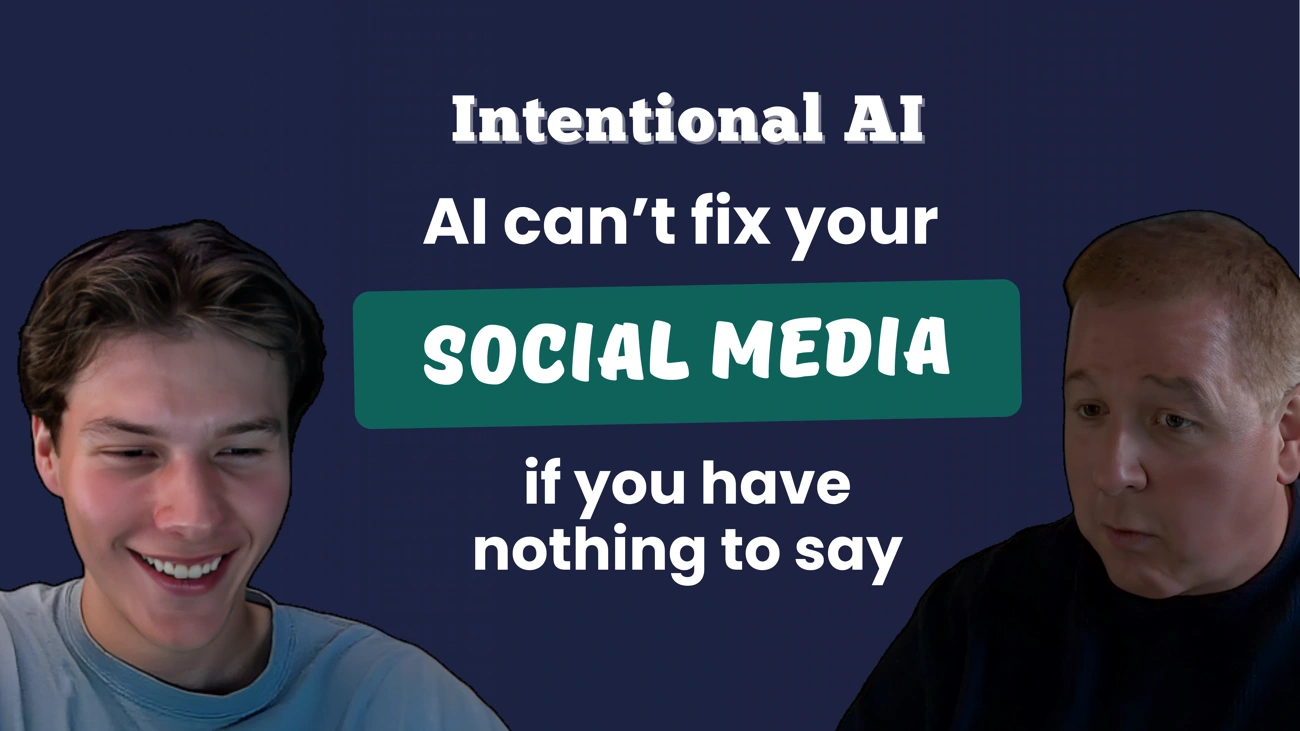
Intentional AI: AI can't fix your social media if you have nothing to say


Show Notes
AI-generated social media content is everywhere right now. The question is not whether you should use AI for it. The question is whether what you are producing is actually worth putting out there.
In this episode, Cole and Virgil get into the honest version of this conversation. Social media is already oversaturated. The algorithm rewards activity, but activity without a message is just noise at scale. The real problem with a lot of AI-assisted social content is not that it sounds like AI. It is that there was nothing behind it to begin with.
Cole ran the same prompt across three tools -- Gemini, ChatGPT, and Claude -- asking each to write a LinkedIn post promoting an article from earlier in the series. The source material was not great, the prompt was intentionally minimal, and the results reflected that. Each tool handled it differently, and the gap between them comes down to how well each one understood what LinkedIn actually requires from a post.
The takeaway is not which tool won. It is that the output ceiling is set before you open the tool. Know what you actually want to say, then use AI to help you say it faster and across more formats. That is where it earns its place.
Previously in the Intentional AI series:
- Episode 1: Intentional AI and the Content Lifecycle
- Episode 2: Maximizing AI for Research and Analysis
- Episode 3: Smarter Content Creation with AI
- Episode 4: The role of AI in content management
- Episode 5: How much can you trust AI for accessibility
- Episode 6: You’re asking AI to solve the wrong problems for SEO, GEO, and AEO
- Episode 7: Why AI can make your content personalization worse
- Episode 8: The real value of AI wireframes is NOT the wireframes
- Episode 9: Just because AI can create images doesn't mean you should use them
- Episode 10: The Super Bowl didn't sell AI, it exposed it
- Episode 11: AI video rewards planning, not your ideas
- Episode 12: AI might struggle with creativity, but coding isn't creative
- Episode 13.1: What the rise of conversational search means for your website
- Episode 14: AI agents are only as good as your workflow
New episodes drop every other Tuesday.
For more conversations about AI, design, and digital strategy, visit https://www.highmonkey.com/podcast and subscribe on your favorite podcast platform.
(0:00) - Intro
(1:17) - Today's topic: AI social post creation strategy
(1:58) - The social media volume crisis
(4:33) - Start with your message, not the tool
(6:14) - Good AI use case for social media
(6:56) - On standing out
(8:04) - Focusing on small wins
(10:48) - AI has evolved and so have our perspectives on it
(14:28) - We tested 3 tools for AI social posts
(15:42) - Testing Gemini
(17:49) - Testing Claude
(20:39) - Testing ChatGPT
(22:52) - Replacing monotony is not replacing creativity
(24:23) - Closing thoughts
(25:14) - Outro
Subscribe for email updates on our website:
https://www.discussingstupid.com/
Watch us on YouTube:
https://www.youtube.com/@discussingstupid
Listen on Apple Podcasts, Spotify, or Soundcloud:
https://open.spotify.com/show/0c47grVFmXk1cco63QioHp?si=87dbb37a4ca441c0
https://soundcloud.com/discussing-stupid
Check Us Out on Socials:
https://www.linkedin.com/company/discussing-stupid
https://www.instagram.com/discussingstupid/
Transcript
VIRGIL 0:00
Well, if you've been wanting an episode where you actually get to hear Cole break out of his shell, this one might just be the episode for you. We're talking about social media and AI, and let me just tell you, he has a lot of strong feelings about it, but the reality is strong feelings should be had because there's a lot around social media that goes wrong today. And can we use AI to use it right? Well, if that's something that interests you, join us as we get ready to start discussing stupid.
VIRGIL 0:11
Hi everybody. Welcome back to the podcast. Following a couple of weeks of just great interviews, we decided we get back to just being Cole and I.
COLE 0:20
Back to the basics.
VIRGIL 0:25
But here we are. Today we're going to talk about a little bit more about content creation, but now a little bit different angle on it. We've kind of talked about content creation, we've kind of talked about using AI in kind of social media campaigns and that kind of stuff. But now we're going to actually talk about using AI in the creation of social media posts. Right, Cole?
COLE 0:51
Yeah. Everyone's favorite medium to interact on, right? Social media. Social media and AI. What a duo.
VIRGIL 0:59
That's - you know, I love my social media. Lots of factual information I get on a daily basis.
COLE 1:07
Yeah, I mean, let's be real, like social media is just oversaturated with information on basically all platforms. I mean it's going to be different per platform, but I mean we've seen so much in the 2020s, especially the last couple years, just with AI - anyone can put out a lot of content. The question is, can anyone put out good content?
VIRGIL 1:35
One of the things with social media that's so difficult right now is just even getting noticed. And like, how do you get people to even notice you on social media? So, AI to the rescue, right?
COLE 1:48
Yeah. Oh my God. So it's the type of thing where you'll be on YouTube and you'll see someone saying, oh, I made a thousand posts with ChatGPT and Canva in three minutes. Like, that is the problem with the internet in my opinion. I think that's genuinely the problem because, sure, yeah, like the algorithm rewards activity, but it's like - how many messages are we seeing circulating on a given day and our brains aren't meant to handle that. This is an experiment and we are the guinea pigs. That is my opinion. Like, this is probably the most opinionated I've been.
VIRGIL 2:25
Well, and the reality is being the creator of those - I mean, you're right. What a lot of people are doing that are leveraging AI is just letting AI do all the work for you and just creating this crap out there. But for people that I'm sure are our listeners, which are professional social media people and marketers, there could be a benefit because a lot of what we actually have to do is kind of monotonous and repetitious. And you take a good example, like you're creating a post and that's all great. Well, what's one of the first things you know about it? You don't want that to be your only post. Typically if you kind of have a campaign around that, you're going to create variations of that post and use different information so that you can post at different times and that kind of stuff. Well, that's all stuff that takes time to do. And we've seen the social media tools that we've used have a lot of different fancy things. Like I was trying to remember the one - they call them evergreen posts, but there's the recycler where you could write it with little variables in it so that you could replace words in that. But the reality is it still all takes time and so maybe AI can fit in there and make it all better.
COLE 3:52
Well, yeah, the reality is you don't need to put as much effort into crafting like every single word of your message. That's kind of an understatement. But you still really - it's highly advised by me at least to know what message you want to put out. Let's say you're promoting some content, like let's say you're promoting a blog like we've been doing over the course of this series. Kind of know what you want your main messages to be that people actually get from that piece of content, and then maybe push that in batches. Like, maybe you have like four or five key points from that article. How about you do a post really diving into that, and then another post really diving into the next thing.
VIRGIL 4:38
I think that's such a great point because initially from the social media side, I'd say one of the benefits of using AI in it versus kind of long content is you don't have to edit as much. So if it gets it wrong, maybe it gives you a good idea and you can work with that. But what are we seeing as a trend, especially on LinkedIn, which is one of the areas we focus on because we're targeted towards professionals - we're seeing a lot more longer form posts, these really elaborate posts that people do where they deep dive into a subject, and it really is almost another form of blog posting but you're doing it on your feed. And so that kind of defeats the purpose. If we already know it kind of does a crappy job on long form content, then it probably is going to do a crappy job on long form social media posts. But if it's something that's 160 characters or less, I mean, how bad can it really be? And that's a facetious question.
COLE 5:40
Yeah, well, you know, so one thing - it's funny you say that because I think a very good use of AI for social media is let's say you have a bit more of a long form LinkedIn post or a blog post, and segmenting that into like a thread. So you take the different parts of that and break it down by like under 280 character bits and it just kind of does that for you and you can put it into a Threads thread or a Twitter thread or what have you.
VIRGIL 6:12
Yeah, it's like - but team. In teams.
COLE 6:15
Exactly. But that's the thing - that's another example of this doing the tedious for you, and it's based on something that you've actually put a lot of effort into. Okay, that's the main thing I wanted to say in this episode - I think standing out on social media isn't about using AI anyways. Isn't about just using AI to craft the most human sounding content. I think it's about knowing what you want to put out there and kind of leveraging the automations of AI in the process. Because the reality is - and I've been there - I understand a big usage of AI for social media right now is like generation of content. But then it's like, okay, it seems kind of AI written so you end up tweaking it to sound more human written. But what if you start from a more bottom up process? Do you get what I'm kind of getting at here, Virgil?
VIRGIL 7:24
I do. And before we go any further, if everybody can't notice, Cole does our social media posting, so he might have a few more things to say than he normally does on a lot of other things here. But yeah, I mean, it's like anything, it's not a perfect answer. I mean, but again, if you're a person that's managing the media accounts and you're like, okay, here's my basic idea that I need - which is where a lot of people are going to start - I need a social media post around this. And then I say I want it to target Facebook, to target Instagram, to target LinkedIn, those kind of things. And you do it, you're probably not going to get very good results. But if you have a message and you're like, okay, maybe adapt this so that it kind of fits the target audience I'm trying to hit on LinkedIn versus the type of image I'm trying to portray on Instagram or Facebook, there's probably a higher percentage. But no matter what, we know that if you're a professional, you're probably never going to use what you get. But maybe it saves you 10 minutes per post in creating it. And that can be a big time saver. I mean, it can help you out. It's not going to be perfect. But again, that's why we always talk about kind of that small wins, or the intentional AI side of this - use it for what it can do well for you. Even in variations, reordering the words, changing the meaning of the post just a little bit so that you could run it again and not be caught up in reposting a lot. So there's opportunities, but it's like anything, it's a slippery slope and you're going to have to find your path.
VIRGIL 9:33
What's even more interesting - and of course everybody who's listened to our podcast knows how much we bash the image editing and how many people are going to use that. Because with Instagram you need a photo and you usually want those type of things, and how it's just going to kind of trickle out and go crazy.
COLE 9:55
Yeah. I would say the image and the video AI content is definitely one of the more noticeable when it's AI generated that you see on social media. But I think there is just a lot more leverage that you have with personalizing AI output in the social media copy department.
VIRGIL 10:21
Well, and it's actually ironic because I have to laugh a little bit, because when we think about when we started this - I mean, you're the one that suggested doing almost an entire season on AI. I was kind of skeptical about that because I've kind of been skeptical about AI, and as we've went through this process, I've actually - I still have my skepticisms, but I've come to see more and more how it could be used in a very intentional way. Where you have kind of went this other curve, which is you've become more skeptical and more bitter about AI. And that's probably because, honestly - and being upfront with everybody - Cole uses AI a lot more in his daily work than I do in my daily work. So there's kind of a big difference there. But it's what we preach throughout the entire thing. You have to find a balance on this stuff.
COLE 11:16
That's all. That's what it's all about.
VIRGIL 11:18
And as we're learning more and more, there is no right tool. There's tools that do certain things better and certain things other. Now, maybe when you did your testing, you found the perfect tool to use for all social media AI. But again, it's kind of one of those things where you start having a tool for this and a tool for this and this strength and that strength. And I've always said it - boy, wouldn't it be nice if we just had a tool that did everything I wanted it to do versus this one doing this part well and that one doing that part well. But Cole, you did some testing.
COLE 11:54
Yeah, well, it's funny you say that in particular because, so just for starters, models have gotten better since we started the series. I will say. But so Claude - it's pretty much consensus the top tool to use right now. I mean, it has its pros and cons, of course, like any model, except.
VIRGIL 12:16
For people that work at OpenAI, and I doubt they have that.
COLE 12:20
Yeah, I bet. I bet people who work at OpenAI use Claude.
VIRGIL 12:23
Yep. I know. They just released a new model, so we'll have to use it for some testing at some point.
COLE 12:27
Did they release - are you talking about Mythos or.
VIRGIL 12:30
Yeah, yeah.
COLE 12:32
See, I thought they didn't release that one to the public, but.
VIRGIL 12:36
Or it's in beta. I can't.
COLE 12:38
Yeah. Anyway, either way. So I use Claude for the majority of my AI usage. But so in the tool test that I did, it was pretty much me taking the same article that we generated back in - man, was that October? I don't even know. So that article, man, looking back at it now, it's just not the best piece of content. But it's funny now having AI come up with something good from that.
VIRGIL 13:15
You know, something we could do - fun - in our last episode as we kind of wrap this up, we should have the tools redo it with the new one.
COLE 13:21
We should, we should.
VIRGIL 13:21
We should. Absolutely. I think that's a great idea because I think that's one of the challenges we have with AI in the first place - we in technology are kind of used to technology changing all the time. But this AI, I mean, it's changing every two minutes. One day you're doing it, and the next day it's a completely new model and it does things completely different. And that's a lot for people to keep up with.
COLE 13:45
And it's a ton to keep up with. But the good news is I don't really think it's that crucial to keep up with every little update. I think you've got to just keep the core foundational practices at play and focus on small wins. But anyways, yeah, so the tool test. I had three tools write a LinkedIn post promoting this article that we wrote back in October. And the prompt that I actually used was: using the attached article about digital accessibility, write a LinkedIn post that promotes the article to a marketing and content professional audience. The post should highlight the most compelling argument from the article, drive the reader to want to click through and learn more, and sound like it was written by a person. Keep it under 150 words. No emojis. Added that in there myself.
VIRGIL 14:40
Emojis. Yes.
COLE 14:42
I'm not even going to get to that right now. So the tools I used were Gemini, ChatGPT, and Claude. And I used the Sonnet 4.6 model. So the tool results actually surprised me a lot. I was anticipating Claude just blowing everything out of the water. But I'll start from kind of my least impressive to most impressive in my opinion. So first off, Gemini. It pretty much did technically exactly what it was asked to do. It took the article and kind of summarized it. Took the article which was basically a regurgitation of the initial research we did before that initial content piece, and it just kind of made a smaller version of it. Yeah, it wasn't anything too pretty. The CTA wasn't very good at all. So I just kind of see that as a summary. I mean, I'm sure Gemini can be leveraged way better. Google has just insane amounts of data. Did you take a look at the Gemini output at all?
VIRGIL 15:58
I did, yeah. I mean, Gemini is - I think it's intriguing because you look at AI and you always think of kind of Claude and ChatGPT, and Gemini is kind of this third option that seems to be way ahead in the game. And I've seen some good things. It seems like it does some pretty good things with logic based stuff. And I know our next episode we're going to be talking about analytics and that kind of stuff, and obviously that's no surprise considering Google Analytics is the god of analytics. Gemini has some strengths in that area to help you analyze that kind of stuff. But I mean, I know for the other times that we've used Gemini, it just seems to fall down a little bit in kind of creating original content. Though in general, AI does that.
COLE 16:51
However, kind of off topic but at the same time on topic - I don't know how familiar you are with NotebookLM, but man, there's some crazy stuff. It's Google's - I don't even know how to describe it. It's like an AI model but you can pretty much put context in there and it'll create all this supplementary content for you. I uploaded like a spreadsheet of my music genre trends over time and it created a whole podcast.
VIRGIL 17:18
Oh nice.
COLE 17:19
It was creepy. It was creepy but also kind of insane technology. So anyways, moving on to Claude. Claude, believe it or not, was the middleman here. It was stronger content than Gemini, better structure and whatnot. But I just didn't really like the style of the particular post. It leaned a bit reactionary, which technically is better for social media because you want stuff that people will go, no, I disagree. So it said - in our initial article we had referenced that the average settlement with accessibility violations on your website is $350,000. Now I don't know the numbers behind that, but I just thought it was kind of reactionary to put that in the post. And also just the style of the post. Maybe I'm just sick of reading Claude's style.
VIRGIL 18:20
Yeah, I mean, it also could be that maybe part of its logic model - and I can't say it is - is to do something more reactionary. Because if you're trying to get noticed, I mean, look at today. Now 95% of the news articles out there that you see on the web are "you won't believe what happened next" or they put a lot of innuendo in there and a lot of inflammatory words trying to get people to click on it. So maybe that's part of what they've built into their model. Clickbait.
COLE 18:55
Yeah, and you know what, that could probably be it. And of course -
VIRGIL 19:00
Listen to me being all positive guy, like maybe they did this on purpose. But yeah, no, I know what you mean.
COLE 19:06
And like the post was all right. The post was all right, but where I put it below ChatGPT in this case was the CTA was just a bit too literal. Like the CTA was "worth a read if you're in marketing, content, or digital strategy." Like, I don't know, I just don't feel like you should be that literal with your audience. It just feels like you're going, hey target market, check out our content.
VIRGIL 19:31
Well, that's AI. AI tends to be very literal in a sense. And that's just part of the gig. And that's where you talk about people having to do work afterwards - it's not just a final copy paste and go.
COLE 19:50
This was going to need some work afterwards. This particular one. And of course in the pre-prompting process you can really hone your brand voice. Claude has tons of features to be able to do that in a project. You can just add all the context you ever need. And of course there's the memory too that links between chats. So yeah, I mean, Claude was all right. You just have to tweak it to your liking. And then ChatGPT though, man - that's what I used from pretty much 2023 to this year, mostly. And I don't know, has it gotten better? Because the way it promoted the article - and mind you, I pretty much started fresh from ChatGPT, like I don't have much context in there at all - but it blanketed the best possible statistics from the article in some pretty decent content. And the CTA speaks directly to the reader versus like the other two. Gemini and Claude had kind of weak CTAs, so it felt more like conversational versus trying to complete a task with AI.
VIRGIL 21:10
Yeah, well, and I think you talk exactly like what we talk about all the time. I mean, the entire nature of AI is situational. Otherwise it's going to give you different answers at different times and the way you ask the question and everything like that. And that's kind of the point. At the same time, different tools are going to have different strengths. It could be that just the way the article was written, ChatGPT was able to process it better than Claude or Gemini. And if you had one written completely different, it could be the exact opposite. And that's both the opportunity, but also the frustration. And I think the way to get around that frustration again is people have to realize that this is part of your process. This is not going to be the end result. And maybe in a few rare occasions you're like, oh, that's really well written, I'll use that as is. But overall it's going to be part of your process. And because it worked once - and I think that's the biggest thing - because it worked once doesn't necessarily mean it's going to work the same way with a different piece of content using the same prompt. I think that's huge. And I think we'll probably talk about that more in our final prompt episode. But the reality is it's always going to be based on what you're using it for. And so if you're looking to use this to replace things - which is such the trend, talking about AI replacing work and all this kind of stuff now in big corporations - maybe there's some opportunity there just because there's probably a lot of redundancy in a lot of organizations. But overall, in general, when you start saying to replace creativity, which a lot of this process is about, you're just not going to get the same level of satisfaction that you get if you're trying to replace some monotonous process in a long business process workflow.
COLE 23:14
Yeah, which is funny because I bet where AI could be used best for social media is like regulatory announcements, where it's kind of the same cadence each time and you're not trying to get people's marketing attention. But I bet that's not really a super hot place where it's used, like government - because they probably need to - I don't know what laws are in place in terms of government agencies using AI for content output, but I just feel like that's murky waters in terms of the legality of that. But yeah, man, what an interesting one.
VIRGIL 23:57
Yeah, I mean, and it is, it's all with a grain of salt and what you can do. But I do think it's fun as we kind of wrap up this episode - I'm pretty sure if we used AI and went back and counted the number of words you said in any given episode, you pretty much rocked the boat this time. And you probably spoke maybe even more than me, which is quite impressive to do because I'm not such a silent person.
COLE 24:26
Get a Gen Z kid talking about social media, they won't shut up.
VIRGIL 24:30
Yeah, right, right, exactly. Well, we'll make sure to move on to something that doesn't make you talk so much, like analytics. That's quite an exciting topic. But anyway, thanks for sharing the test with us and thanks everybody for joining us and have a great rest of your week.
COLE 24:48
Thanks, everyone.
VIRGIL 24:54
Just a reminder, we'll be dropping new episodes every two weeks. If you enjoyed the discussion today, we would appreciate it if you hit the like button and leave us a review or comment below. And to listen to past episodes or be notified when future episodes are released, visit our website at www.discussingstupid.com and sign up for our email updates. Not only will we share when each new episode drops, but also we'll be including a ton of good content to help you in discussing stupid in your own organization. Of course, you can also follow us on YouTube, Apple Podcasts, Spotify or SoundCloud, or really any of the other favorite podcast platforms you might use. Thanks again for joining and we'll see you next time.
Latest Episodes
The new WCAG 2.2 rules you're already breaking (part 2)

The new WCAG 2.2 rules you're already breaking (part 1)
Season 4: The Teaser
Sign up for Discussing Stupid updates
Get the latest Discussing Stupid episodes, expert insights, and exclusive content- straight to your inbox