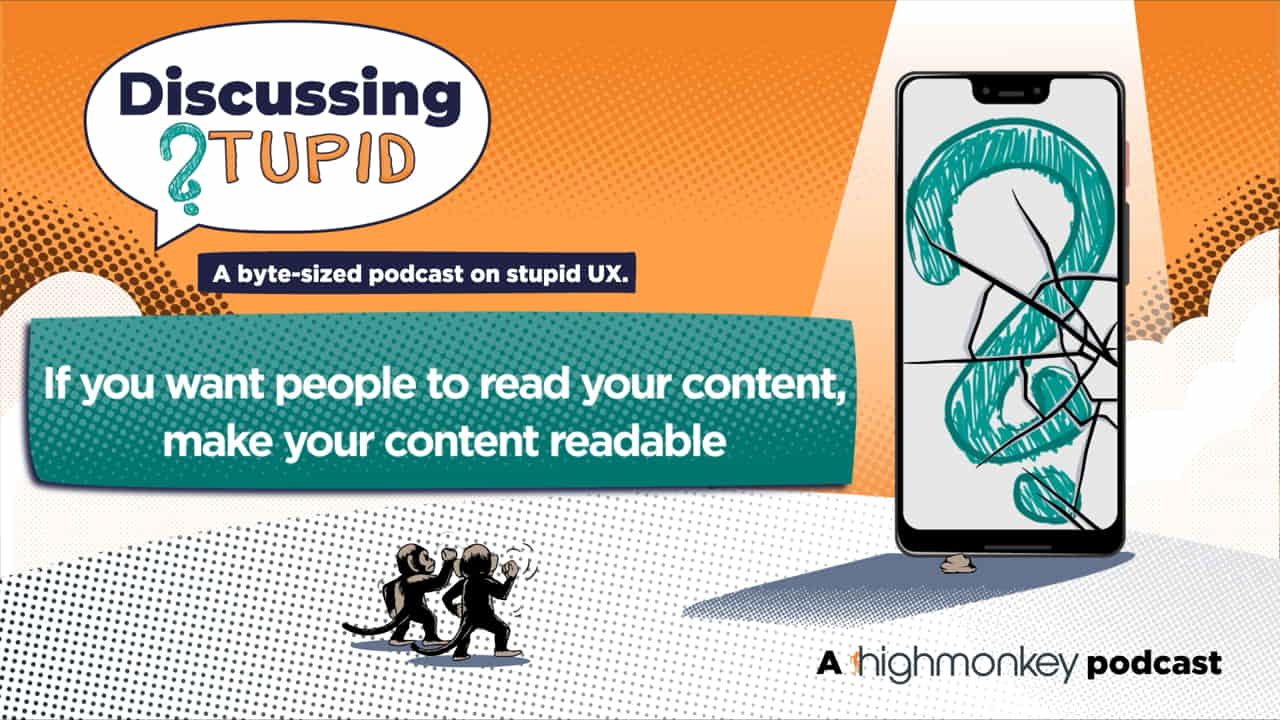
If you want people to read your content, make your content readable!!


Show Notes
In Episode 3 of Discussing Stupid Season 2, host Virgil Carroll, along with Cole Schlotthauer from High Monkey, dives into the topic of content readability. They focus on how overly complex or technical language can turn users away and make it harder for people to understand.
The team discusses common readability mistakes like using too much jargon, confusing sentence structure, and not keeping the audience in mind. Virgil shares examples from government and education where content wasn’t simple enough. They explain why it’s important to know your audience and keep language clear, especially for government websites that need to be at an 8th-grade reading level.
The episode also includes a demo using Readable.com, where Virgil and Cole show how to take a sentence and make sure it is clear and easy to read. This example shows why keeping content simple helps people understand and stay engaged.
By the end of this episode, you’ll have tips to make your content easy to read and understand, reaching a wider audience.
LINKS
Tools Mentioned:
Readable.com: https://www.readable.com/
Readable.com Demo Clip:
Watch a clip of Virgil and Cole using Readable.com to enhance content clarity:
Subscribe for email updates on our website:
https://www.discussingstupid.com/
Watch us on YouTube:
https://www.youtube.com/@discussingstupid
Listen on Apple Podcasts, Spotify, or Soundcloud:
https://open.spotify.com/show/0c47grVFmXk1cco63QioHp?si=87dbb37a4ca441c0
https://soundcloud.com/discussing-stupid
Check Us Out on Socials:
https://www.linkedin.com/company/discussing-stupid
https://www.instagram.com/discussingstupid/
Transcript
VIRGIL 0:03
[intro music plays] If it takes you a lot of effort to read something to yourself, then you can almost guarantee that it's going to be really hard for somebody reading the text to read it to themselves as well. Hi, everybody, and welcome back to the podcast.
COLE 0:44
Welcome back!
VIRGIL 0:44
As always I'm your host, Virgil Carroll. And with me today is...
COLE 0:48
Cole Schlotthauer from High Monkey.
VIRGIL 0:50
And, just to tell everybody right now, Cole is very nervous because this is the first time he's like being a full participant in this conversation
COLE 0:59
Yeah I guess... I've just been asking questions and guiding conversation.
VIRGIL 1:02
Instead of just asking questions, he actually has to contribute. So if, you get a moment-
COLE 1:06
Bear with me!
VIRGIL 1:07
write a quick note of compliment, in the comments. That is, I guess, if you like what we talk about today. and speaking of that, COLE, what are we talking about today?
COLE 1:18
Yeah, we're just talking about content readability.
VIRGIL 1:21
Okay. Yeah, that's very important in there.
COLE 1:24
Indeed it is. just more specifically, like, you know, all about how easy it is for your audience to understand, you know, what you've written. If it's too complex, people probably aren't gonna stick around. There's a lot more to than that, so.
VIRGIL 1:39
Yeah, yeah. Content is a complex process. I mean, you know, there's a lot of moving pieces that go into it
COLE 1:47
Right.
VIRGIL 1:48
and everything. one of my favorite stories from that always is, you know, years ago, years and years ago, I worked with a government agency, and, you know, like a good example is, you know, there's a federal mandate, that governmental, websites, be at an 8th grade reading level. And, that's kind of funny because 99% of them are nowhere even close. but as one of the first exercises we did with this customer, I sat down with their kind of team, of people that were working with us on website redevelopment, and I challenged them all to take one paragraph that they had written in the past and actually, rewrite it and make it for an 8th grade written level. And, the funny part was, is that everybody rewrote their paragraphs and, we scored it. And almost every single person took the reading level, which a lot of them were at some low level, college reading level, and actually went up in score, which meant that they was actually more difficult to read than down. And that really, you know, a lot of these people were scientists and that kind of stuff. But overall, it kind of goes to the problem. Sometimes people get so ingrained in kind of what they are and how their terminology goes and everything like that, that they can't even see outside of that and what it really takes to take something down to an 8th grade in level. So that's a real big, kind of thing that a lot of, organizations have to get past,
COLE 3:20
Right, I feel like that's the thing we see kind of a lot with organizations and kind of another thing we see a lot too, is people are just not understanding, who their audience is in general, or just not properly connecting with their audience in the way that they do their content. So, you know, for example, organizations, they serve a wide range of people. It might be people who are like, learning English for the first time, or maybe like elderly communities. and, you know, when you write, you don't want to be using overly complex words and sentences and stuff that isn't going to get to these people in the proper way.
VIRGIL 3:54
Yeah, well, and then how about internal jargon? I mean, that doesn't only go for public websites, but also a lot of internal communications. It's amazing how many times I work with companies and just the, the language and nomenclature they use internally, and I just used the word nomenclature. That's a nice simple word there, but they use it internally and they just use it because it's just part of their mind and they're like, this is there. And that's a huge problem. I mean, jargon and kind of industry specifications and that, people use and don't even really think about it because to them it actually makes sense. But it's really to what else there? And I always think if you really want to, kind of do a, poor man's way of really grading this and understanding it, one of the best things you can do is, run your content through, some type of translation service like Google Translate or something like that, and see what actually comes out, from there. Of course, you need a native speaker in another language to know if it actually is good. But a lot of times, especially those kind, of AI based translation systems, they only really do well if you are using very simple language and very simple structured language, and not the typical language that we use when we're speaking about things. And so that's kind of another pain point that happens is a lot of times companies are trying to do support multilingual and that kind of stuff on the cheap. And the way they do that is by using some type of saying, well, they can just, you know, translate it with Google Translate, but they never bother to test it, actually. See how good that is. we've had several customers we've worked with where, you know, basically, you kind of test it and then they're like, oh man, that's really bad. And it's like, well yeah, that's kind of the problem. And the amount of effort that goes into actually, rewriting your content to actually kind of make it, so that it works for that is also going to have the other benefit of also making it good for just people, with lower education levels, that are ESL, (English as a Second Language) and all those different things. So much like a lot of these problems that we talk about, it's kind of all encompassing. There's not like one little piece that you can kind of segment out. It's kind of this overall arching piece that, you know, if you make content readable, you're actually supporting a lot of other purposes for that content besides just a person visiting it, you know, on their web browser and just looking at it as is.
COLE 6:21
Right. So not to switch the tide on you too quick here, VIRGIL, but how about we get into how people can get in the right direction when it comes to content, readability.
VIRGIL 6:34
Well, you know that's a great question and I know you and I kind of talked about it and talked about doing some kind of demonstration for people to kind of understand. And of course, who's easier to pick on, than the federal government. I mean they've got some of the worst websites out there, on the planet and ones that are supposed to be, follow all these mandates and that kind of stuff. So Cole, do you think we kind of show them maybe taking a sentence off, some kind of government site and rewriting that and showing them just how much you, can meet the need and still convey the message yet not use all the words that they want to use?
COLE 7:10
You know, I would, but I think it might be a little, hard to find an overly complex sentence on a government website.
VIRGIL 7:17
Yeah. Okay. Right.
COLE 7:21
So yeah, here, we have a, sentence that I pulled from a unnamed government website.
VIRGIL 7:29
It's the EPA...
COLE 7:30
The EPA. Okay. But yeah, so the sentence is "The Safe Drinking Water Act.(SDWA) gives individual states the opportunity to set and enforce their own drinking water standards if the standards are at a minimum as stringent as EPA's national standards." Now, you know, that sentence got an E grade,
VIRGIL 7:51
What a mouthful
COLE 7:52
on this tool that we were using, Readable.com. and. Yeah, I mean, you can really tell it's very long. there's some structural issues with this sentence, and some pretty complex words being used.
VIRGIL 8:08
Yeah, I mean, it's, you know, readab- read- [VIRGIL doing vocal exercise] Sorry, Readable .com is one of the better sites I've found out there that really has a score. you know, of course we're using the free site right now, but you can also pay and use their professional edition. but yeah, when you look at that score, you can see that it's really failing on everything.
COLE 8:32
Yeah. Like, you know, with all these scores, like Flesch Kincaid grade level, Gunning Fog Index and Flesch Reading Ease so with the first one, you want to be, at a 10, and you're well over that. We're too complex with this sentence right now.
VIRGIL 8:52
Yeah, and just add on to that. I mean, their recommendations for content is for a 10th grade reading level. but in reality, this is a government website. And like I said before, a government website needs to be at an 8th grade reading level. Therefore, you look at, like, the Flesch Kincaid I mean, it's what it would consider grade 16. Otherwise, that'd be, you know, basically a senior level in college. and the Gunning Fox is saying 18. So that actually would be more like a Master's level. So, I mean, when you say this sentence is failing, I mean, it's like FAILING really, really bad. Which, I wish I could say was a unique scenario that we see on government websites or really a lot of commercial websites, but it's not. So they're focusing on making sure that everything sounds very professional and very scientific and everything like that, versus actually building something that is very readable, to the common person that might visit the site.
COLE 9:51
Yeah. And keep in mind, like, this is one sentence on the page that I was on. Like, and just imagine going through a whole website where like, a good portion of the sentences are along these lines of complexity. so, yeah, what I did, as I was saying. Oh, sorry, were you about to say something?
VIRGIL 10:10
No, go ahead. Yeah.
COLE 10:11
Okay. What I did was I rewrote the sentence and just made it less complex and used simpler words. And I also separated it into two sentences because the sentence was very long as is. But now we have an A grade, and all the other individual grade level scores, have improved, and now they're right where they need to be. So, yeah, there's a cool tool, Readable.com. you can use it to make sure that your content is, where it needs to be from a readability standpoint.
VIRGIL 10:41
Yeah, I mean, this is a great example look at just how much easier it is to read it. If you say "The Safe Drinking Water Act lets each state make and follow its own drinking water rules. The rules must be as strict as the EPA's." I mean, you're saying the exact same thing, but overall, it's so much easier. It's so much easier to say, it's so much easier to listen to, and it's so much easier to read. And it is possible to do this and not get stuck in all the kind, of legalese side of things, in there. And it's just an important point that if anybody walks away from anything, it is possible to make your content so much more readable, than what it is today. Well, thanks for sharing that, COLE. I think that was a good example of how you could take a really complex sentence and make, it simpler. And as a matter of fact, what we did here during the demo is probably one of the best pieces of advice that I could possibly give, and that is read the content aloud. And I believe actually in Episode One, when I talked about alt text, I said the same thing, but even more so here. If it takes you a lot of effort to read something to yourself, then you can almost guarantee that it's going to be really hard for somebody reading the text to read it to themselves as well. And you have all the knowledge and understanding of what that content really is going to be. And if you are feeling like it's a mouthful and that you're having to work hard with your mouth to say it out loud, then that's a great indicator that you've just went too far. So it's kind of a poor, man's way of being able to do this is to kind of go through that process of reading it out loud to yourself.
COLE 12:24
Yeah, it's a good rule of thumb there. And kind of following up on what I mentioned earlier, regarding, you know, thinking about your audience, I think in general, it's a good practice to, you know, tailor your content to, the idea or think about the diverse and global audiences that may be interacting with your content. So I think the key is just maintaining simplicity and clarity with that. Like you want to be writing in, you know, thinking about universal, language in mind. So just using words and phrases that people can understand, I think that goes a long way with making readable content.
VIRGIL 13:02
And I mean, from that audience. I mean, if you are an engineering company and you're building a site that is tailored towards engineers, maybe you don't have the same concern level as if you are a government site where the site is technically for everyone. And even though you know, you look at like, the EPA, and the EPA could argue, well, well, most of the time, scientists and people like that are going to be what's visiting our site overall. You don't know that there could be somebody that's doing research for a, paper in high school that's, looking at the EPA site for something, and they just don't really consider that, and when you talk about taking it and really understanding your audiences, we worked with one customer that really kind of understood that so many of their processes were very complex, and no matter how well they explained it, it was really hard to do that. So another thing you can do is add a visual component to that, and that's where your images and that kind of stuff can really come into play, is adding a visual. And, this particular customer, we ended up working with them to build a lot of infographics around it that kind of showed the process of going through kind of a complex governmental process and all the different stages that can go in there. and that really helped not only, assist the content itself, but also for some people that really had that language barrier, give, them the understanding without them having to go through and try and understand the content on the page. So there's a lot of options. But overall, the reality is what people really have to do is they have to focus on, as content creators, on making sure that they understand the people they're creating their content for, understanding how they communicate and then developing that content in the way. And, you know, we talked a little about legalese and scientific, but the reality is, this is much a marketingese as well. People like to say things in very marketing type language that is just not the way normal and natural people speak. And sometimes that goes a little overboard and people don't really get the meaning there either.
COLE 15:04
Right. well, thank you, Virgil, for all the, advice on good practices. And I think a lot of websites could probably use it.
VIRGIL 15:13
Yeah, no, thank you, Cole. I think you did a great job as a first time contributor, a full contributor, that is, to the process. I, think you can finally get over the nerves and know that you can do this. And thank everybody for joining us. as always, we'll have, more information in our show notes in there. but thank you and all have a great rest of your day. [outro music fades in] Just a reminder, we'll be dropping new episodes every two weeks. If you enjoyed the discussion today, we would appreciate it if you hit the like button and leave us a review or comment below. And to listen to past episodes or be notified when future episodes are released, visit our website at www.discussingstupid.com and sign up for our email updates. Not only will we share when each new episode drops, but also we'll be including a ton of good content to help you in Discussing Stupid in your own organization. Of course, you can also follow us on YouTube, Apple Podcasts, Spotify or SoundCloud, or really any of the other favorite podcast platforms you might use. Thanks again for joining and we'll see you next time. [outro music fades out]
Latest Episodes
The new WCAG 2.2 rules you're already breaking (part 2)

The new WCAG 2.2 rules you're already breaking (part 1)
Season 4: The Teaser
Sign up for Discussing Stupid updates
Get the latest Discussing Stupid episodes, expert insights, and exclusive content- straight to your inbox