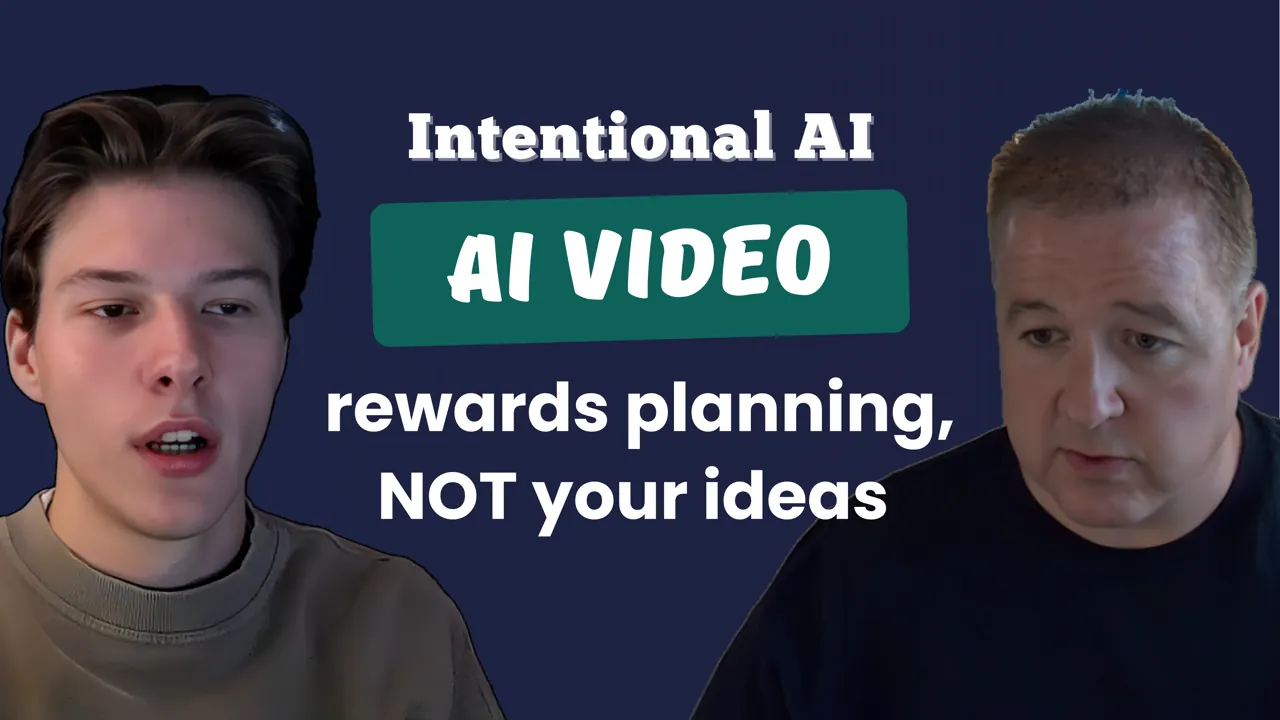
Intentional AI: AI video rewards planning, not your ideas


Show Notes
AI video tools promise fast, cheap production. But what you get back depends entirely on how much thinking you did before you hit enter.
In Episode 11 of Season 3's Intentional AI series, Virgil and Cole take on AI video generation, arguably the most complex and most hyped area of AI content creation. Video production has always been expensive, often running thousands of dollars per minute through traditional workflows. AI tools are pitched as the solution to that cost. The reality is more complicated.
The core question Cole raises early: are you using AI for speed, or for creativity? With video, that matters even more than with text or images, because the ability to edit what AI generates is extremely limited. You are largely working with what comes back.
Virgil tested three tools, Claude, Artlist, and Sora, using the same prompt and the same source article the series has been following. The results varied wildly. Some tools produced clean, factually grounded output that could serve as a foundation with additional editing. Others burned through resources quickly and delivered results that raised more questions than they answered (to put it lightly). Each tool had tradeoffs between creative quality, turnaround time, cost, and practical usability.
The pattern held across the board: AI video does not reward vague ideas. It rewards storyboarding, defined objectives, and clear constraints. The most realistic use case is not generating entire videos from scratch, but using AI for individual pieces -- a specific animation, a graphic element, a rough draft to react to.
AI video is getting better. But better does not mean ready.
Previously in the Intentional AI series:
Episode 1: Intentional AI and the Content Lifecycle
Episode 2: Maximizing AI for Research and Analysis
Episode 3: Smarter Content Creation with AI
Episode 4: The role of AI in content management
Episode 5: How much can you trust AI for accessibility
Episode 6: You’re asking AI to solve the wrong problems for SEO, GEO, and AEO
Episode 7: Why AI can make your content personalization worse
Episode 8: The real value of AI wireframes is NOT the wireframes
Episode 9: Just because AI can create images doesn't mean you should use them
Episode 10: The Super Bowl didn't sell AI, it exposed it
New episodes every other Tuesday.
For more conversations about AI, design, and digital strategy, visit https://www.highmonkey.com/podcast and subscribe on your favorite podcast platform.
(0:00) - Intro
(1:04) - The good & bad of AI video generation
(1:30) - Are you using AI for speed or creativity?
(3:56) - Structure up front = your best friend
(7:28) - How Coinbase used simplicity to stand out
(8:42) - More Super Bowl AI narrative unpacking
(10:20) - We tested 3 tools for AI video generation
(11:47) - Testing Claude
(14:24) - Testing Artlist
(16:32) - Testing Sora
(19:03) - Closing thoughts & takeaways
(21:40) - Outro
Subscribe for email updates on our website:
https://www.discussingstupid.com/
Watch us on YouTube:
https://www.youtube.com/@discussingstupid
Listen on Apple Podcasts, Spotify, or Soundcloud:
https://open.spotify.com/show/0c47grVFmXk1cco63QioHp?si=87dbb37a4ca441c0
https://soundcloud.com/discussing-stupid
Check Us Out on Socials:
https://www.linkedin.com/company/discussing-stupid
https://www.instagram.com/discussingstupid/
Transcript
VIRGIL 0:00
With videos, there's definitely the good and the bad, but probably even more so. There's a lot of ugly out there in that. And if you joined us in our last episode, you heard us talk a lot about the ugly. So now we're going to talk about the good and the bad and being able to use video and AI to create it for your business. If this is something that interests you, then join us as we start discussing stupid. Hi, everybody. Welcome back to the podcast. As everybody that listened to the last episode knows, we kind of took a little detour because we had the super bowl ads to talk about, and we thought it was really fitting because we were talking about video in this episode. And so we split it into two and did a little thing around the Super Bowl. But today we're going to continue on with our Accessibility article in creating videos.
COLE 1:04
Yeah, and to be. To be quite frank, I was kind of dreading doing this episode because when I think of AI video, you know, I think of, you know, like the, the Svedka commercial from the super bowl and I think, like, people asking camels to do the doggy. And I, I think of, you know, Charlie Sheen and Frank Sinatra jousting, stuff like that. But, you know, I think the angle that we are kind of looking at this from, you know, there is a practical lens to using, you know, AI for video, but it really kind of comes down to asking yourself one question is like, what are you using AI for? Are you using it for speed or making up for speed or for creativity? And I think that's kind of where, you know, the AI video discussion kind of starts, in my opinion.
VIRGIL 1:53
You know, you bring up such a good point, because the reality is, it is where I agree that the creep factor is very high there. It is also one of the most interesting areas. I mean, when you think about it, just from, you know, having been in this world for, you know, almost 30 years, video production, not to offend any video producers out there, is a very expensive proposition. I mean, it takes a lot of time. It likes. Takes a lot of money, you know, to be able to do it. I remember even back in, you know, a couple of videos that I did with some customers way back in the day. I mean, it was, you know, anything from a thousand to $5,000 a minute of video to, to go through the production process. And obviously for a lot of organizations, that that's for very prohibitive. The unfortunate part is video, you know, where we talk about images being known for being doctored by AI video definitely, you know, Cats talking and everything else like that. I mean, you have all these different things, but there is a practical, you know, potential opportunity here, and. And it can be kind of unique, but it runs into a lot of the same problems as the others, but I think even more severe. I mean, we definitely know we did a lot of the testing of the AI images and the AI videos at the same time. And, you know, again, kind of going with our philosophy of simple prompts to say we had differing answers from the different systems. I mean, it's probably the understatement of a lifetime. I mean, there was so much interpretation, both good and bad, from kind of how this worked. And I think that's part of the problem, is that it's not even about the way you prompt, but also the more you get into these complex things where they're doing lots of different things, like all these different video treatments and audio and everything like that, you have so much more variability between the tool. Where you use two tools, they're going to do completely different things.
COLE 3:56
Yeah, I mean, unlike, you know, written content and kind of other, you know, areas of AI that we've talked about so far, video and image, like it. There's just not as much granularity in terms of being able to edit what has been been generated. So that. That is especially hard with video. I mean, it depends on the model, of course, but, yeah, you are really kind of going with what AI wants to do unless you define a lot of stuff up front. And that's kind of where we talked about, you know, if you have a very, like, repeatable format for your video, like, you know, you have, like, everything storyboarded, you have. That's where we see the, you know, the real benefit with AI, Right?
VIRGIL 4:41
And that's so important because the reality is the storyboarding set, you know, step is so critical, you know, and, you know, I mean, when you think of all the different components of, like, creating a video, you have kind of the. The, you know, the tech side, you have what are going to be the visuals in it, you know, any interactivity, you know, animations, that kind of stuff. Whatever's happening in the video, you have the audio. You not only like, you know, if it's like, can have a voiceover or something like that, but not only that kind of audio, you also have, you know, music in the background and that kind of stuff. And it's interesting because, you know, I mean, much like that, Svedka, you know, video, it's cool what you can get it to do. I mean, whether There that video was creepy or not. I mean, it's still sweet that you can get something to do that. It's. It's crazy. But, you know, the technology is. Is kind of mindboggling to say you can give something there. But the reality is, is probably if they honestly shared the process that they did with this, they probably did little micro pieces and had video editors bringing it together and put in their own overlays of voice and music and all that kind of stuff. I doubt AI did all that in one pass from one prompt. And that's kind of the thing. This is going to be something that could be end up being very useful and honestly could save you a ton of money, which cannot be trivialized in today's world. Everything's getting more expensive, so, you know, businesses need that savings. But the reality is, is there's a good chance, especially the first few ones, but arguably all of them, you're going to put more time into trying to get it to do what you want than you're actually going to get out of the video itself. And that. And so there's a reason that video is an expensive proposition, and that's because it takes video editors a lot of time to do a lot of things. I mean, even for our podcast episode. Yeah. Now that we're, you know, a full season into us actually doing the editing, you know, it's still. It. You know, it still takes a few hours just to do it. Even when you have minimal edits in it. You know, when I say everything right in one take, it still takes. It still takes a lot of time to put it all together. And. And our stuff is very simplistic.
COLE 7:14
Right. We probably could use it to automate
VIRGIL 7:18
or, you know, if you have this kind of thing for an advertisement for your company, you're not going to go very far from. You know, there's an expectation there. That's. The other part is, you know, when you start doing these videos, I don't want to keep going back to the Super Bowls, but there was the ad by Coinbase, the cryptocurrency one that was like all letters that were like 80s and shooting in and that kind of stuff. And it was very simplistic. And actually, in that particular instance, it was very smart because we saw these highly graphic, you know, highly animated things, all these crazy things. And this one just stood out because it was so ordinary. It was a good contrast, and it was a good contrast. But overall, most of the time, if you just release that as a commercial, not in the context of the super bowl, that would have been not well received. It would have been like, looks like they spent $10 on this. The only thing that was, was the, the swoosh effect of the text in there. And so you kind of have that balance. You're going to have to have. And the reality is this is probably another area that most organizations are going to find wanting to actually be successful with it. But at the same time, you know, depending on what you want to do, could it be good enough in certain situations? Sure, maybe.
COLE 8:42
Yeah. It's just again, like, you know, you have to, you know, up front, just define a lot of stuff. But like, if we're kind of going by the logic of keep coming back the super bowl. But like, if we're going by the logic that they're like, presenting like, like the kind of dominant narrative, like, type in a sentence, push your button. Here is. Here's your entire product. Like, I mean, and it does again, go back to what I said at the beginning of the episode two. You know, creativity versus speed, like, with art list, they're just. They're saying like, you know, make a panda do gymnastics. Like, and I. I don't know, is that, is that like, something that people are like, really banking on helping their. Their business? I. I can't really imagine.
VIRGIL 9:24
But, you know, one thing I think about the super bowl and, and. And then we can kind of get off the subject is there is that old PR adage, you know, no news is bad news, or, I mean, no press. Yeah. Bad news is no. How is it. Yeah, basically any type of news is good. My God. I just totally. Anyway, and the reality is, is that all these things are talked about, and let me tell you, the bad ones are talked about a lot more than the good ones. And if the entire purpose of that advertising is to get you to talk about their company. Do you remember baby monkey or whatever? Monkey. You know, monkey. Monkey. You know, that was a couple years in the Super Bowl. I mean, that is monkey. Yeah, yeah, the. The creepiest one. Anyway, anyway, but from, from a perspective of somebody wanting to put something together, you know, we wanted to kind of go down that path again and kind of see it. So in this particular instance, you know, as always, we, we tested three tools. We tested Claude, we tested Art list, which we used for the images specifically. And then I wanted to try test Sora now, which is obviously the most well known and some of the most doctored AI videos that have the most controversy is out there in that. And so the prompt I used was Using the attached article that is our accessibility article, create a short promotional video concept for Instagram and TikTok that runs under 10 seconds. Break it into several quick frames that each show a simple message based on broad themes from the article. Keep the visuals clean, readable and minimal so the key ideas are easy to follow. Do not add messaging that does not appear in or clearly align with the article. Now the reason I added that is because we're, we're well aware that these videos are known to hallucinate and just make up stuff in that. So, so, but overall, you know, cut has started off well and that. So I started off with Claude and I input it in there and got decent back. I mean, I'll, I'll say decent. It was the only one out of the three that gave no audio or music or anything. And that's because Claude isn't licensed for that stuff. But it gave like five screens each sitting, two seconds each describing one of the kind of key facts from the article. Boring. I mean, the colors were muted, the styles were muted. You know, there wasn't really much to it. It was just, you could tell it just kind of used clip art for it. But in the end, if you had a video editor and you could bring that in and overlay your own music and that kind of stuff, slow it down, speed it up, you know, it could work and it was factually correct. It just wasn't very inspiring.
COLE 12:38
Yeah, I guess like based on what you asked it to do, it kind of did it, you know, like it, it came up with something. And yeah, again, if you could work with it, that would be, that would be a thumbs up, but.
VIRGIL 12:51
And that might end up being, I mean, you know, the one thing we don't talk about is what if you could use it for a piece, you know, you know, we've seen that writing entire article, you know, and content is bad and, and doing a lot of these things, the entire thing together. But what if you could use it for just a small piece? You know, say I need a graphic for this or I need an animation around this part that you would bring into your video. It's probably more realistic that you could get something better back from that than if you try to do it, you know, have it build the entire thing. And I, you know, it's, it's kind of this entire intentionally. I thing about find the parts that work and use it for that and don't, you know, and if that saves you 10 minutes, that's still 10 minutes saved.
COLE 13:38
Yeah, yeah. I mean, up Front. I would honestly say make your. Make your own video with maybe like, I don't know, something like that, and then just kind of have the same process reenacted is where I think would be good with AI and kind of going through your workflow with. With that.
VIRGIL 13:58
Absolutely. And the one thing I know is that I am, I am more and more impressed all the time with the way Claude does this stuff. I mean, you know, if I was to give you. If I'm getting biasness, Anthropic's models are just good and they've just released more, you know, which are even better, which we're going to have to use in probably using it later episode.
COLE 14:20
Yeah, they have that. Okay. No, can't get off topic.
VIRGIL 14:23
Yeah, right, right, right. Yeah, yeah, yeah.
COLE 14:25
So what was the next tool that you.
VIRGIL 14:28
That was art list and artless about this. When we talked about images. You know, the interesting thing about Artlist is that they. You can select different engines, but you have tokens that you get assigned. And so I could only do this a couple of times, but oh my gosh, there's bad and then there's disaster. You know, this episode's going to get flagged by them for their. Their copyright too. Okay. Side story. Nobody needs to know anything about that. But anyway, the video is just terrible. I mean, it, it did do audio. The audio is unclear. It goes at about 500 words a second of narration. The graphics, the. The animations are just a cluster. If, if you do anything from this episode, you need to go look at this video and know that we use the exact same prompt. And this is a video I got back because none of it's legible. You can't see anything. It's. It just. It kind of just meshes things together and everything. It's just crazy. I mean, it's rain rot. It's 100 brain rot. But not even brain rot that anybody could on, you know, make sense of, because such a gobbledygook. Let's. Let's use a technical term, gobbledygook. And that's what it is. I mean, you want to see it?
COLE 15:50
Check it out? I will have it.
VIRGIL 15:53
Absolutely. And if you haven't, we have in the show notes everything from every episode. So you really should think about seeing that kind of stuff because it's just so interesting to see in that. So, yeah, I'm going to call it a failure. I mean, obviously maybe if I had more time and spent some time with Artlist, maybe I could figure something out. But the reality is just to produce a 10 second video. Took most of the tokens on my, my, my basic subscription. So it's just not a very practical thing for experimentation. You'd have to pretty much learn it beforehand, I think, or buy a massive amount of tokens, which is not all that great.
COLE 16:30
Yeah. How was the. Is Sora the next tool?
VIRGIL 16:34
Yeah. So Sora, I mean, obviously Sora is the one that probably anybody's heard of, you know, it has both a good rep and a bad rep. Has a good rep for being able to do amazingly realistic videos and it has a bad rep for being. Being able to do amazingly realistic videos. But Sora is a whole different beast. When you use it, you're put in a queue because Sora is being used millions of times a day and that. So I put the prompt in and I finally got notification that my video was ready to go four days later. Now, honestly, it's the best out of the three. I mean, not only does it have good animations, but kind of followed along with a blog about five screens with good animations. Good points from the article. But it also has really clear narration over top of it. Too fast. The speaker speaks really fast. It tries to get way too many words into the narration. But overall, arguably, if we were to say one of these we could use, this one is the most usable and has the most creativity around it. But there's a couple of downfalls. One, it took four days, you know, now you probably can play it, pay a more premium price and get to a higher level of an account than I do and maybe you get that turnaround faster. But overall, you know, who can wait four days to know that you made a mistake and then turn around and do it? I mean, you could take 12 months to build one video, you know, depending on what you're doing there. So there's a big thing there. The second thing is, is that, you know, like most of these, what would be ideal is that you could actually export the audio and the video and separate it out, you know, do stuff with that. Now, if you have good video editing tools, obviously you could do that, you could slow down the voice. But overall it's going to change the tonality of the voice and everything when you slow it down. So that's not really an ideal scenario. If, if I had to do all over again, you know, I probably would have went back. I was really curious to see what it would do if, you know, for like a voiceover and that kind of stuff and bringing it in there and that. But I didn't actually say anything about speaking. It just, it just did that. Which, which is interesting, but I probably would have preferred to have non speaking where I could do my own voiceover and I kind of stuff. The reality is Sora did the best and it, it was definitely the most thorough and in what it presented back. But overall, if I had a thought, I would have probably made this longer than 10 seconds or been more defined better. The key points I wanted to pull out of the article, that kind of stuff versus just kind of saying you, you determine. But I mean, to me that's part of understanding how smart the AI really is, is you come back there and it's interesting that they all kind of followed the same pattern of five, two, two, two second blocks. Cole, I just lost your video. What did you do?
COLE 19:46
My, My camera cap fell over the lens.
VIRGIL 19:50
Oh, okay. Yeah, Blooper. All right. So anyway, the, the whole thing there is that, you know, you would probably want to define things much better than what I did. But overall we are really testing the brains of AI and whether we can use it. And it comes back to that overall general challenge that people are going to have is that if you're a one person shopper, if you're somebody that is trying to do this to save time, the reality is the more you do things to save time, probably the more time you're going to spend doing it in that. That was much better than the analogy I tried to make earlier about the news and that. But I mean, I mean that's, it's, it's. The reality of the situation is that these things are potentially usable. Yeah. There's the ethical considerations and all that. We didn't talk about that lot here because we talked about that so much during the super bowl ad episode before this. But overall there is a lot of opportunity. But that opportunity is going to probably be more micro opportunities to do individual things. And you're still going to have to put a lot of effort into the planning, maybe even the video editing yourself in that. Or you're just going to have to be okay with what you send. But if anybody's learned any lessons is that you send something out there that people don't like, you're going to hear that a lot more than if they do.
COLE 21:18
Indeed. So, I mean, maybe unfortunately there is some incentive to put out some really kind of sloppy, terrible content because then people will be like, hey, this is bad. And they'll interact with. Then you'll get more views. Wow.
VIRGIL 21:30
I mean, that's. That we're, we're in a meme culture now.
COLE 21:32
So yeah, that is kind of what it is. But yeah, I definitely think there's some good applications of this here technology.
VIRGIL 21:40
Yeah. Well thank you everybody for joining us. Hope you enjoyed this episode and we'll see you on the next one. Thank you all. Just a reminder, we'll be dropping new episodes every two weeks. If you enjoyed the discussion today, we would appreciate it if you hit the like button and leave us a review or comment below. And to listen to past episodes or be notified when future episodes are released, visit our website at www.discussingstupid.com and sign up for our email updates. Not only will we share when each new episode drops, but also we'll be including a ton of good content to help you in discussing stupid in your own organization. Of course, you can also follow us on YouTube, Apple Podcasts, Spotify or SoundCloud or really any of the other favorite podcast platform we might use. Thanks again for joining and we'll see you next time.
Latest Episodes
The new WCAG 2.2 rules you're already breaking (part 2)

The new WCAG 2.2 rules you're already breaking (part 1)
Season 4: The Teaser
Sign up for Discussing Stupid updates
Get the latest Discussing Stupid episodes, expert insights, and exclusive content- straight to your inbox