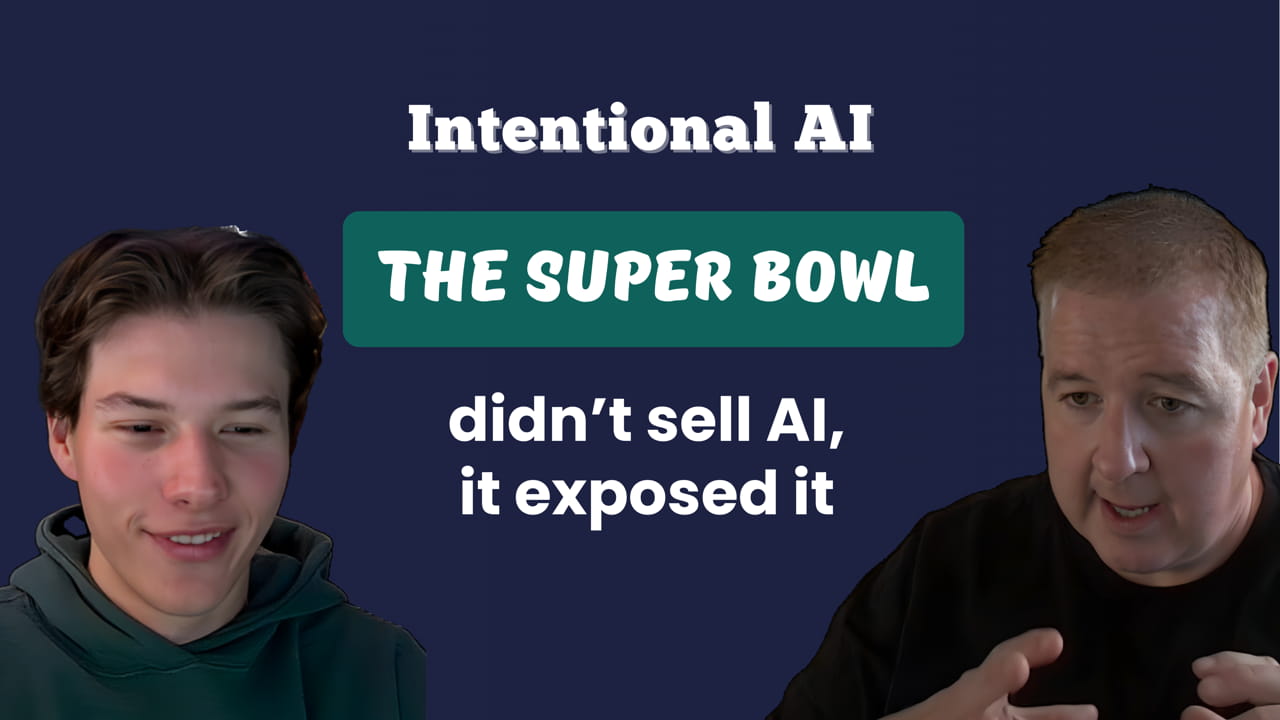
Intentional AI: The Super Bowl didn't sell AI, it exposed it


Show Notes
In Episode 10 of Intentional AI, we are taking a short detour in our Intentional AI series totalk about the Super Bowl. Not the game. The ads. A noticeable chunk of them leaned hard into AI. On the surface, it felt like a big moment for the industry. But when you look closer, it raises a different question. Are we watching real progress, or just very expensive hype?
This week, we unpack what was actually being sold, what was implied, and what gets left out when AI is positioned as effortless.
AI has value. We are not arguing that it does not. But it works best when it is used intentionally and within clear boundaries. When it is marketed as a replacement for thinking, planning, or strategy, that is where things fall apart.
If you are trying to separate signal from noise, this one is for you.
Previously in the Intentional AI series:
- Episode 1: Intentional AI and the Content Lifecycle
- Episode 2: Maximizing AI for Research and Analysis
- Episode 3: Smarter Content Creation with AI
- Episode 4: The role of AI in content management
- Episode 5: How much can you trust AI for accessibility
- Episode 6: You’re asking AI to solve the wrong problems for SEO, GEO, and AEO
- Episode 7: Why AI can make your content personalization worse
- Episode 8: The real value of AI wireframes is NOT the wireframes
- Episode 9: Just because AI can create images doesn't mean you should use them
New episodes every other Tuesday.
For more conversations about AI, design, and digital strategy, visit www.discussingstupid.com and subscribe on your favorite podcast platform.
(0:00) - Intro
(0:42) - We had to talk about the Super Bowl
(2:05) - The numbers behind AI in the Super Bowl
(3:55) - How AI is marketed vs reality of AI
(7:30) - This is why we started Intentional AI
(8:30) - Reflections on the current realities of AI
(13:20) - Where does AI make the most sense?
(15:30) - Our reaction to the AI generated ads
(17:30) - Join us and learn to be responsible with AI
(19:00) - Outro
**Also disclaimer: there is a math error at 18:15 - the correct calculation is closer to $100-150 million.**
Subscribe for email updates on our website:
https://www.discussingstupid.com/
Watch us on YouTube:
https://www.youtube.com/@discussingstupid
Listen on Apple Podcasts, Spotify, or Soundcloud:
https://open.spotify.com/show/0c47grVFmXk1cco63QioHp?si=87dbb37a4ca441c0
https://soundcloud.com/discussing-stupid
Check Us Out on Socials:
https://www.linkedin.com/company/discussing-stupid
https://www.instagram.com/discussingstupid/
Transcript
VIRGIL 0:00
You know, sometimes when you're doing a series as long as this, you've got to stop and you got to have a little interlude and you got to look at something different. And we had the Super Bowl not too long ago, and we saw the crazy AI videos and we just felt like, wow, we really have to talk about this and what this really means, considering our entire season so far has been about AI and using it. So if you're interested in the good, the bad and the ugly of what we thought about the Super Bowl and all the AI companies out there, join us as we start discussing stupid.
VIRGIL 0:42
Well, you know, sometimes in the middle of a, what are we up to? 400 part AI series or something right now?
COLE 0:49
Something like that.
VIRGIL 0:50
Yeah, yeah, you need to have an interlude. And though we probably didn't really plan on it, after watching the Super Bowl, we just felt like we had to talk about what was being sold there.
COLE 1:04
Yeah, I mean, you know, it's just the biggest day in advertising the whole year. It's like it's a company's Christmas, big company's Christmas, if you will. But it was just pretty staggering to see the amount of AI advertisements that we saw during the Super Bowl commercials. So off the top Virgil, I want to quiz you, actually. So they're-
VIRGIL 1:26
I just gotta say this, though. One of the most interesting headlines I read was basically something that, that, you know, AI spent millions trying to sell us stuff we didn't want there. So that. That'll be a good kickoff from there. So anyway, go ahead.
COLE 1:43
Well, yeah, that's pretty much what it was like. And I mean, you feel like the desperation kind of like on their end of like, crap. We have. Okay, we've invested so much money in this. Like, how do we, like, convince everyone that it's like, worth buying into?
VIRGIL 1:59
And not scary as crap.
COLE 2:01
Yeah, like, oh, my gosh, it was wild. But okay, so there were 66 ads that aired during the Super Bowl. How many of those do you think were involving AI?
VIRGIL 2:17
I didn't watch all the ads because the game itself was kind of boring. So I didn't pay as much attention as I normally do. And I didn't actually like most of the ads, so I'm going to say probably 75, maybe 80%.
COLE 2:32
Well, it was actually 23%, but it felt-
VIRGIL 2:34
Okay, wow. It felt like that. I mean, yeah, yeah, I'm going to disagree with that. So they might have been AI specific, but like the one, like the Dunkin Donuts one in that. So no matter what the way they de age people is through AI so, you know, it probably didn't count in their ticker. But overall, a lot of the things they do to like clean up things or add backgrounds, that. That's all AI.
COLE 2:59
Yeah, I think, you know, they should just use the actors as they were in that one, in my opinion.
VIRGIL 3:04
Yeah, I actually think it would have been funnier if they would have just showed them as being as old as I. Yeah.
COLE 3:09
But, you know, back to what you first said, the amount of money spent on, you know, the AI call spent on these quarters in the Super Bowl, I, I looked up before the, before this recording. So one 30 second Super Bowl ad spot costs 8 to 10 million dollars. And that's just the, like the ad spot. So, you know, and honestly, it's funny like the amount of money spent in the, in the production of the ad, given that a lot of them are used with like, you know, varying levels of AI, I gotta imagine it's just a fraction of.
VIRGIL 3:41
Oh, yeah, I'm, I'm sure it is. I'm sure it is in that. So, I mean, it's, it's just crazy. What, what the Super Bowl ads, which is why we wanted to talk about it. I mean, let's be honest, the, the cringe factor of, you know, there's kind of the two sides of this that, that are applicable to us. One, how businesses are trying to use AI and two, what AI is basically trying to sell us that you can use it for. So there's really two pieces of that. And you know, to me, so many of them were, were cringy. I mean, they were just cringy. They were trying to lean into what everybody's fears are. And I don't know, I mean, maybe there's people that actually think that they sold them on. Oh, it's not that scary when, you know, we talked about like the, the, the, the Alexa plus one where, where, you know, Chris Hemsworth is looking at all the different ways he could die. You know, it's like, it's so funny because we've had movies about that stuff for so long and in TV shows and everything. And it's not that far of a leap. I mean, all it takes is one more step and it to be like, you know what? You're interfering in me doing my job. So here, go stand under this garage door and let me drop it on you. You know, and, and that they leaned into it and thought it was funny watching a bunch of kids. I, I don't know. It's crazy. That's not really the point of our podcast, but there's probably some motivation around what they're doing.
COLE 5:04
Well, this whole thing, it really stems back to why we started this series in the first place, is because the way AI is marketed, they make all these claims about how much easier it's going to make your life and how seamlessly integrated it'll be into life. But the way they advertise it, they make it seem like all you have to do is push a button and then AI is just going to do everything for you. But that's not how it works, you know? And...
VIRGIL 5:26
And in all fairness, that that's Marketing 101, and that's been marketing for a long time. I mean, marketing is always supposed to be about telling you that everything's going to be easy and this is going to make your life a hundred times better. I don't necessarily fault it for that. It's that there are a fair number of people that believe that and that will believe its answers. And the thing is, like, if I get new, you know, if I get a new lotion and it says it's going to make my skin baby soft, I can put the lotion on me and I can feel across there and go, you know, did that make my skin feel baby soft? And so I have something provability here. AI will sit there and say, I'm going to do these 10 things for you, and it's going to do it the way it thinks you want it. And then you're going to take it at face value and you're going to hand it into somebody else, and they're going to go, what the hell is this? This is not at all what I wanted in that. Or it's going to sit there and you're going to ask it for advice, and it gives you advice to do something that you didn't intend to do, which actually the Claude commercials, they were actually funny because obviously they were picking on OpenAI and that OpenAI wants to add ads to make more revenue in their thing. But I laughed, and to me, Claude did something. But they also indirectly pointed out 100% AI in the first place. It was scary how much the people playing the AI bots were very much like, oh, great question. I love that you asked this. And, you know, all that and everything that kind of goes along with that. And then on the other side, it's like, you know, well, now that you did it, let me offer you lifts for your shoes because you're short you know, and, and that, but AI does that anyway. I mean, it would take the ads out of it. It'll sit there and suggest stuff that never even came in the realm of even being a thing. And, and we see ads and articles and all this kind of stuff and it really is, it's why we did this series because we believe in intentional AI. Otherwise we believe AI does have its purpose as a tool, but right now it's very much being sold as the answer. And the problem for organizations and probably a lot of people listening here is somebody higher up the pay scale than them has watched this stuff and learned this stuff or been sold by, you know, high tech salespeople and they're like, oh my God, this shiny bauble, it's right here, it's great, let's take care of it and do it. And they're all like, what the hell do we do? Because it doesn't work that way, you know, and, and there's just so much there, you know, take just the entire video side out of it of creating AI generated videos and, and just go into the practical AI applications. And it really is being sold as something that it doesn't live up to at all.
COLE 8:20
Yeah, I, I mean, I don't know, I feel like it's kind of reflective of, of society in a way. Like, like the uses that they're trying to present for the AI. It's, it's like, you know, people are so tired of, people are like, oh my God, like, you know, they have all these tasks at work or whatever and it's like if they can find a piece of technology to kind of like replace their effort, it's all about like saving time and effort. And that is really what these companies are selling in these commercials like you look at. But it's, it's, to a disturbing degree though is the thing like with...
VIRGIL 8:54
It's human nature to want, you know, something to make your lives easier. I mean, we have a million different products out there that are about making our lives easier. Some of it is, is good in that it actually improves society. Some of it is taking us closer probably to, you know, if you've ever seen Wall-E, the Pixar movie and where, you know, all the people are sitting in there and they can't even stand up because they have their little portable chairs that do it. I mean, it's a slippery slope. But obviously we're not here totally to talk about this. We're here to talk about this. So one of the most ironic things is, you know, one of our themes of our podcast has been using very simple prompts, you know, and just asking it to do something simple and seeing what happens. But that's also what they do in commercial. Obviously they're not going to do a commercial where they have a prompt that's, you know, 20 pages long, but at the same time they're like, take this spreadsheet and make it better. Well, I've done that. You remember when I did that on the one spreadsheet and I showed you that and I was like, what the hell did it even do? It did nothing. It added all these colors that didn't match. It made it like an old times New Roman font, which just looked terrible. And it didn't compile any of the. It did nothing. But that was me using AI to do this stuff.
COLE 10:10
No, it generally sucks because, like, there's a lot of great uses for AI, but you just. It's not like, you know, like the type of sentence and push a button and then like, you're good. It's like you have to identify a lot of constraints and then you, you have to like really, I mean, outline the whole process and then it's about like kind of doing a task, like repeat it in a repeatable manner way faster. But it's not like, oh, like, I don't know, I just keep thinking about like, the, where should I put my potted plants in my yard? Like, why do you need AI to tell you that?
VIRGIL 10:44
And there, well, and there's kind of irony of it, you know, the ones that kind of say, use it for images or videos, you know, which is kind of this part of the series in here. It very much is kind of funny because, you know, like, I'll take one. The Wix one. Okay. The Wix one was like, you ask AI say, this is the way I talk to people. And it's just going to build me a website. And websites are something we maybe know a little bit about. It's going to build me a website in that. And what I really laugh at is not only did it build the website, but then you see the person there dragging the words in a place so that it's around the images and looks very aesthetically pleasing. That's awesome. But what business person understands design well enough to be able to do that? What business person understands design well enough to describe a design so that it would build something that doesn't look like everybody else's thing and use 150,000 different templates that are out there in that. And that's what people don't seem to get. AI is not creativity. AI is looking at patterns and using that to try to do something. Now those patterns, you know, in, if I'm a small business, that's probably okay. But I, you know, most of the people that listen to our podcast and are there, they're in more, you know, mid market to larger market type marketing groups and that kind of stuff and you're not allowed to do that stuff. So you've got to have the designers. So if you have the designers that have to sit there and plan that all out and figure out exactly what you want and then you try to use AI to implement that. Most designers know that it, that the planning can sometimes take four times as long as the implementation itself. Therefore, are you actually saving yourself any time? And I always laugh at that because, you know, like the tool that we used before, our current tool that we use for our website and, and for anybody that's curious, we use that because none of our staff that build websites have any time. So Cole and I have to do it and I'm not as practiced as I used to. So we, we use tools that make it a little bit easier. But you know, we really like their innovation. And then they just stopped. And why did they stop for like nine months? Because they were building AI to be able to do it. And it was like, look at this, you can create a five column layout with AI. It's like, I can create a five column layout in about 30 seconds with HTML and CSS. How did you just save me time? But that was like their sales point. It's like, oh, this AI is going to take over and it's going to automate everything. And it's like, no, I mean, even with like Figma, we've tried using the AI and we're like, okay, that's great. But boy, if we don't know specifically what we want, it's not going to give us anything.
COLE 13:34
Yeah, I mean, you know, these ads, they just kind of felt like a big scramble to get people to buy into the hype. But unfortunately like, that isn't really what gets the ROI that people are like seeking with this type of technology.
VIRGIL 13:51
Well, I mean, I've been in technology long enough to know that everything has a hype level, everything has a buzzword level, and it all eventually implodes. Doesn't mean that it doesn't eventually become a very useful tool. And I really do think AI has its place. Obviously, if you needed to do things like advanced calculations or help you understand complex problems or look at a wide variety of information and bring it down into something sensible, you'd never get any disagreement from me. You can't always rely on the results, but overall you've got that. But when you start using it in the side that we're talking about, so in building websites and all that kind of stuff, it just falls down too much. It falls down too much and it's being sold like it's going to be the savior. If you have five people on your web team, by the time you implement AI, you might only need like a halftime person to do everything you need to do. And it's just not true. I mean, but that's what is being sold. Because they're companies that want to make money and therefore they're telling you that they can do that. Yeah, it was in their little demo. It works.
COLE 14:52
Yeah, tell that to Genspark who they're like, I don't want to work today.
VIRGIL 14:59
Yeah, that was funny. I'm going to say that I have a lot of respect for the actor that was in that because obviously I've seen him since I was a kid in there and I didn't have a lot of respect for. I mean, you know, that, that to me is a money grab type role right there. Because we, we know that stuff isn't true now, though, though. You can do cool things. I mean, you can do cool things and, and you can do that. But, you know, I would. I was giving you the analogy. You know, when, when, when you start talking about how easy or hard this stuff is to do. I mean, even for like my holiday show that I do here at my house, I, I use AI to do a Santa voice and a goblin voice and there to do two overlays over the show and that kind of stuff. And if I just put in a paragraph and say, read this, it'll read it. Maybe with a little bit of emotional inflection, but not really anything. I've got to sit there and use their syntax to add pauses and say words that I want stretched out and all that kind of stuff. And there's a lot of effort that goes in there to get two sentences down to sound like it's actually Santa Claus or to sound like it's actually a goblin saying, muahahahaha, you know, and that kind of stuff. I mean, there's the reality of it. And these commercials. Now, I know we wanted to kind of keep this episode short, so I think we should talk about the other side for just a few minutes, which is the AI used in there.
COLE 16:24
Like the Svedka one.
VIRGIL 16:26
The Svedka one. Okay. Yeah. I don't even know. I mean, it's like this hyper realism thing that AI does is just so cringy. It just feels like it in that. There's one side of me that's very happy that it does that, because you can tell that's AI if it ever gets to the other side. I get really scared about it being just too realistic.
COLE 16:55
Well, you know, it probably will. I don't look forward to that day. I mean, there's already some pretty hyper realistic, similar AI video stuff out there. Like, I mean, even. And this isn't quite the same thing, but the Artlist commercial where. Where it was like, hey, we made this commercial for like, or, you know, very easily. And like, you. You can type in a sentence and...
VIRGIL 17:21
Yep. And I was like, I don't even understand what the commercial was trying to say. It was like, you know, it was like...
COLE 17:29
Probably that you can make crap and put it out there.
VIRGIL 17:31
All I can say is that the marketing or the PR firms or whoever, the marketing firms that did these, they. They should have some questions because sometimes they get all sold on. Just as long as you make something look cool, it'll sell something. But, you know, from that side, it isn't. And you know, if you stuck with us here kind of towards the end, I'll just say, what was the point of this episode? Well, it was to talk about, you know, kind of AI in real life and. And what organizations are doing. And you figure. How many Super Bowl ads you said 66 and 23%. So 23% at 10 billion a spot is 230 billion. Or, sorry, 10 million. 10 million a spot. That's [$100 – 150 million] spent on AI and that. And you know, anybody that knows the stock market at that time knows that they lost billions in market cap at the same time. So I'm not sure that return on investment is exactly there. And again, I fall back to the article I said, you know, they spent millions on selling us things nobody wants, and that's the reality of it. Hopefully, eventually they'll all back off and realize, but until there's some standardization, some different things like that, we're just stuck with the crap. And, you know, our job in doing this and your job in using it is to be responsible and to figure out the right places to use it. And I'm going to say probably the best places to use AI right now is where nobody knows that you used AI.
COLE 19:04
I fully agree. And if you want to learn more about how to do that, listen to this series.
VIRGIL 19:10
Listen to this series and our next episode is about videos. So and we're not going to be nice about those because the videos we had are just crazy ridiculous.
COLE 19:20
Oh man.
VIRGIL 19:22
So we'll have some fun with that. So thank you everybody for joining us.
COLE 19:25
Yeah, thanks everyone.
VIRGIL 19:33
Just a reminder, we'll be dropping new episodes every two weeks. If you enjoyed the discussion today, we would appreciate it if you hit the like button and leave us a review or comment below. And to listen to past episodes or be notified when future episodes are released, visit our website at www.discussingstupid.com and sign up for our email updates. Not only will we share when each new episode drops, but also we'll be including a ton of good content to help you in discussing stupid in your own organization. Of course, you can also follow us on YouTube, Apple Podcasts, Spotify or SoundCloud, or really any of the other favorite podcast platform we might use. Thanks again for joining and we'll see you next time.
Latest Episodes

The new WCAG 2.2 rules you're already breaking (part 2)


The new WCAG 2.2 rules you're already breaking (part 1)
Season 4: The Teaser
Sign up for Discussing Stupid updates
Get the latest Discussing Stupid episodes, expert insights, and exclusive content- straight to your inbox