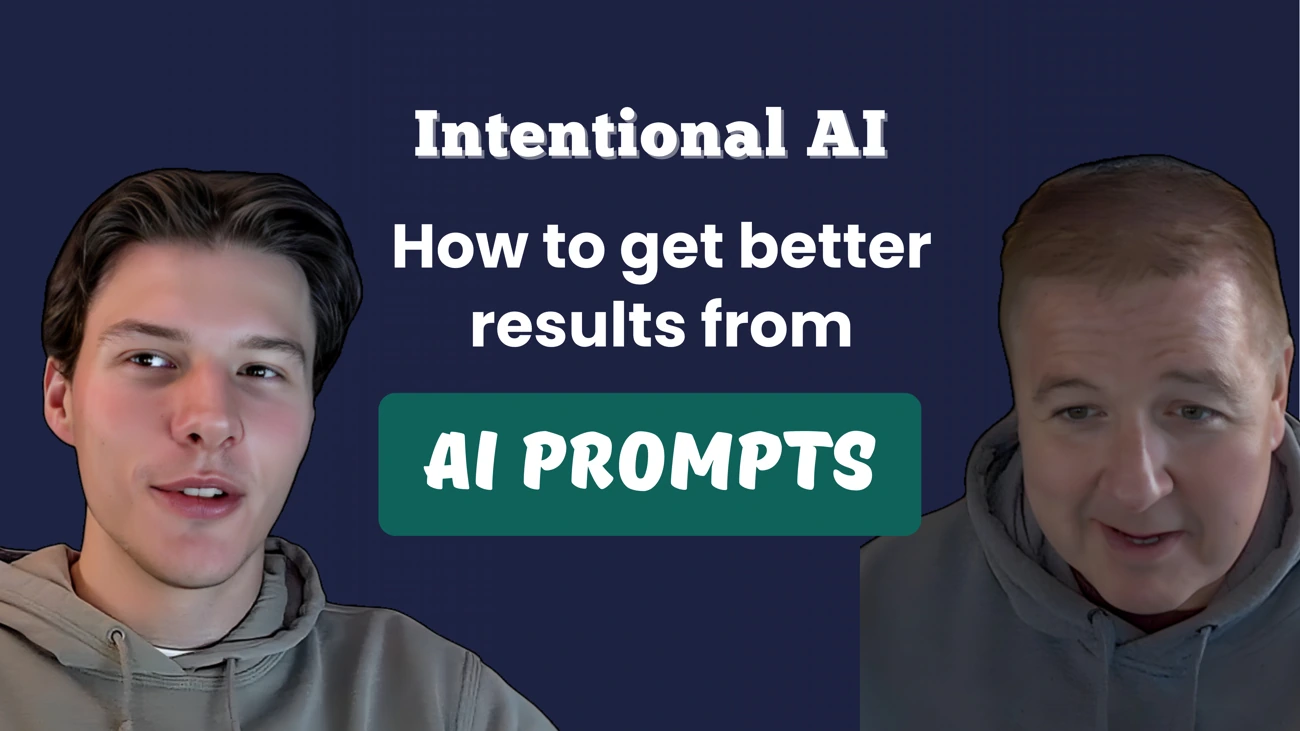
Intentional AI: How to get better results from AI prompts


Show Notes
Near the end of Season 3, Virgil and Cole sit down to look back at the prompts used throughout the Intentional AI series, what worked, what did not, and what that gap says about how most people approach AI.
The conversation starts with a simple premise: the prompt itself is not really the point. The words you type are just the output of a more important process, which is knowing clearly what you want before you start. When that clarity is missing, the prompt cannot compensate. When it is there, even a basic prompt tends to work.
One of the more durable takeaways from across the season is that asking AI what to ask it is a legitimate strategy, not a workaround. When you do not have a clear framework for your task, AI can actually help you build one. Ask it what information it needs to do the thing you want done. From wireframes to strategic planning, that back-and-forth approach consistently produced better results than leading with a one-shot prompt and hoping for the best.
The episode also draws a clear line between creative and analytical tasks. Across the season, analytical and pattern-based tasks like coding, research, and schema building tended to produce more reliable results. Creative work was another story. Not because the tools are broken, but because creativity requires judgment the AI does not have and the human has to supply. And that supply only works if the human actually knows the domain they are working in.
That last point carries the most weight. Domain expertise is not just helpful when using AI - it is the variable that determines whether you can evaluate the output at all. If you do not know what good looks like in a given area, the AI can produce something plausible and you will not know whether it actually helped. That reality is a big part of why so many AI rollouts have underdelivered, and plays a part in a lot of the AI backlash we're seeing.
Previously in the Intentional AI series:
- Episode 1: Intentional AI and the Content Lifecycle
- Episode 2: Maximizing AI for Research and Analysis
- Episode 3: Smarter Content Creation with AI
- Episode 4: The role of AI in content management
- Episode 5: How much can you trust AI for accessibility
- Episode 6: You’re asking AI to solve the wrong problems for SEO, GEO, and AEO
- Episode 7: Why AI can make your content personalization worse
- Episode 8: The real value of AI wireframes is NOT the wireframes
- Episode 9: Just because AI can create images doesn't mean you should use them
- Episode 10: The Super Bowl didn't sell AI, it exposed it
- Episode 11: AI video rewards planning, not your ideas
- Episode 12: AI might struggle with creativity, but coding isn't creative
- Episode 13.1: What the rise of conversational search means for your website
- Episode 14: AI agents are only as good as your workflow
- Episode 15: AI can't fix your social media if you have nothing to say
- Episode 16: The most important operation in analytics - understanding your "why?"
New episodes drop every other Tuesday.
For more conversations about AI, design, and digital strategy, visit https://www.highmonkey.com/podcast and subscribe on your favorite podcast platform.
(0:00) - Intro
(0:55) - Today's topic: AI prompts
(2:45) - You never know where a prompt will take you
(5:10) - Ask AI what to ask it
(7:05) - The repeatability problem
(9:00) - Creative vs. analytical: two very different conversations
(11:20) - One area where AI delivers: Research
(14:00) - Domain expertise = major missing variable
(16:45) - The AI backlash was predictable
(19:05) - As AI models continue to evolve, so will our workflows
(20:45) - Closing thoughts & finale preview
(21:27) - Outro
Subscribe for email updates on our website:
https://www.discussingstupid.com/
Watch us on YouTube:
https://www.youtube.com/@discussingstupid
Listen on Apple Podcasts, Spotify, or Soundcloud:
https://open.spotify.com/show/0c47grVFmXk1cco63QioHp?si=87dbb37a4ca441c0
https://soundcloud.com/discussing-stupid
Check Us Out on Socials:
https://www.linkedin.com/company/discussing-stupid
https://www.instagram.com/discussingstupid/
Transcript
VIRGIL 0:00
Prompts, prompts everywhere and not really sure if we can use them or not. If you've been interested in the lessons we learned about the prompts we use throughout this series this season, this will definitely be the episode for you. So if it interests you, join us as we start Discussing Stupid.
--------
VIRGIL 0:31
Well, Cole, we're coming towards the end of the season now, and I'm actually kind of excited about this episode. I always love to be able to kind of look back and see what we did. So what are we going to be talking about today?
COLE 0:46
Well, yeah, just as you said, we're going to be looking back and kind of seeing what we did in the prompting department of the series, you know. Yeah, this episode's about prompting. So kind of the most important part about AI in, in some ways, but also the prompt itself, like the words itself, the syntax and all that isn't, you know, at the end of the day, the important part. The important part is like, knowing what you want to add.
VIRGIL 1:19
Getting the result. Getting the result. But. But I totally agree. I mean, it's. You know, I think I wanted to think I knew so much about AI, but the amount that I've learned more about AI over the last year, nine months, however long the season's been going, is just kind of exponentially. And I think a lot of that is really centered around prompts and the way we word things, the questions we asked. I mean, obviously we learned, asking a simple question, you can get a wide variety of answers. And some of them good, some of them not so good.
VIRGIL 2:02
Yeah. And that one.
COLE 2:04
On that note, we talked about this episode, I think, like a week ago, and you mentioned you have a sprinkler system that has, like an AI chat feature in it, correct?
VIRGIL 2:15
Yeah. Yep.
COLE 2:17
And you had asked the sprinkler system for data, and you got like, you know, it basically, like, shut down on you. And I think it's so funny because, you know, sometimes, I mean, you could ask the same type of prompt to. I mean, I don't know what other sprinkler systems would have the same situation.
VIRGIL 2:39
You could ask in your ChatGPT, Claude, something like that.
COLE 2:42
It would take an answer and it would run with it. It's. It's like. It's unbelievable, the variability of. Of what you can get out of the same prompt. So.
VIRGIL 2:51
Yeah, yeah. And it is. I mean, I was actually. I mean, you know, from there, so. So to give a little premise, my. My sprinkler system, you know, they added an AI chat because everything had to add an AI chat to it. I don't know why, but, you know, it's supposed to use, you know, use the NOAA weather patterns and kind of decide when it needs to run and that kind of stuff. And that appears to be working. But every time I log into the app, I get an error saying a summary screen can't show for the weather. So I decided to ask the AI chat, I said, my weather is not working. Can you help me fix it? And it says, I don't know how to answer that question. And then it ended the chat. It didn't even let me continue to ask a different question. It just ended it. Which is funny and probably for most people, frustrating. But I agree. I think the thing it teaches us is that one of the problems with AI still today, it's getting better, but overall, still today is even if it doesn't know the correct answer, it's normally going to give you an answer. It's going to try and give you something because it just feels like it has to do it, whether it's going to hallucinate and go in a different direction or it's going to completely misunderstand what you're talking about. That, and that is a big thing that I think is really lacking in the AI world right now is it's okay to not have an answer. It's okay to say, I don't have enough information. And I think that's what we learned, especially from our simple prompts, is that we would ask simple prompts, and instead of coming back and saying, you know, you're not giving me enough information, if you gave me this additional information, I could give you better in that. But instead, what did it do? It would just spew out. You know, and like when we did the creation, you know, content creation episode, it just basically spewed off stats and excerpts from other, other articles and, and that kind of stuff. I mean, it answered the question, but overall, it could have said, if you want me to be more unique to you, what do I, you know, need to do?
COLE 4:58
Yeah, I mean, that's really where the best experience with AI happens is when you have a specific kind of thing you have in mind that you want accomplished, and then the AI should be able to tell you what it needs from you to get that result that you specified.
VIRGIL 5:19
Right.
COLE 5:19
That you want.
VIRGIL 5:20
So that comes to our first lesson we learned. If you don't know what to ask AI, ask AI what to ask it, if that isn't just a good word jumble. But I mean, right there, I mean, we did that from wireframes. During the wireframe episode, we said, we want to create a wireframe with you. What information do you need to us to be able to create a wireframe? And it gave me the framework of the information it needed to be able to do that. And then I was able to work with inside that framework. And I think right there, if you don't listen to any more of this episode, walk away with that feeling right there. Don't be afraid to ask AI what information you need to give it for it to give you a great result. I mean, I don't know if I talked about it on the podcast, but I know you and Cole. Cole, you and I have talked about, you know, when I was doing some strategic planning and I had found somebody's prompt that they had created that was like two pages long on how like to do some strategic planning. But the great thing about it is, is it gave a framework and I filled in my information in there. But on top of that, it started a conversation where it started saying, okay, I understand you want to do this. Do you see? This is more a priority. This is more a priority, and this is more a priority. And I would kind of go down that path. And it ended up with, you know, like a hundred pages worth of information. But overall it was kind of a. A wizard, self directed type process that, that really helped me get down to what I really needed from it. Were the answers perfect? No, still, I mean, you know, when you ask it to kind of be creative, it just doesn't do very well. But asking AI to help you ask AI the right questions is important. And I think one of the areas is, and this is something AI has always suffered with, is repeatability. You know, if you want to use it in your process, you want to be able to feel good that you're going to basically get the same result depending on how you do that kind of stuff. And I think that you could ask it, say, what's the information I need to give you to be able to make this successful but also be repeatable.
COLE 7:41
Yeah. Which is kind of a lot to ask unless you're using a spreadsheet as a databases, honestly.
VIRGIL 7:49
Yeah.
COLE 7:49
Excuse me. You know, that's something actually that I believe in one of our past episodes we covered. But yeah, it's an interesting scenario.
VIRGIL 8:06
It is the recovery. It is. And you know, it always goes back to one of the first articles I ever read about AI kind of being used in a practical situation. It was with Microsoft Copilot and you were building out your, your own agent. And part of the prompt process that the person put in place was some conditions in that. And it would say one of the conditions was don't hallucinate, don't answer things that you don't know the answer to. Now, I never saw how actually well that handled it, but I mean, from that side it is, it is such a valuable thing. And I think right there is the first thing is to really look at, you know, getting the prompt to help you, you know, figure out what to give it so that it can be successful and repeatable.
COLE 8:57
And this kind of reminds me also of one of the other points that I know we wanted to raise in this episode. And it's beyond the prompt itself. You have to think about the task and what are you actually trying to accomplish in the realm of creative versus analytical?
VIRGIL 9:15
Right. Yeah.
COLE 9:16
And what do we mean by that? Well, are you trying to make something completely new that didn't exist before, or are you trying to take a pool of stuff that happened and data and create a better understanding of that data.
VIRGIL 9:32
In a better understanding? Yeah. Or, or even on top of that to ask it to do something logical, you know, like build a wireframe code, a page, that kind of stuff. Stuff that has patterns that exist out there. So yeah, what, what did you and I find any creativity overall? AI for the most part, failed miserably. I mean it decent jobs. You know, when we think of like with the content creation, you know, we think of, of like Grammarly and how it kind of walked you through a little bit of a process to, to kind of get to, to there. It was asking you basically to create an outline of your article and really think through it in there. And in those scenarios, when you've thought of what you wanted to do, it it was okay, it wasn't great. But again, it's, it's kind of goes back to that entire thing of our entire series intentionally. I in that, use this for an intentional reason. Otherwise if you're under the delusion that you're going to type in a sentence, it's going to give you a wonderful article and you should publish that then, then frankly to me, you're a hack and, and, and you deserve what you get of any comments on that content. And you're just trying to spam out content, but if you want it to help you create quality content, you're going to give it more information. You're going to have actually thought through this, what it's going to happen. It's going to give you something that maybe is 50, 60, maybe even optimistically 70% of the way that you want. And then you as the person are going to have to take that and make it better and fix it. And so using it intentionally is a small part of that process can be really good. I mean, we saw that research. It does research pretty well, as long as you give it good parameters around it, it can find you lots of information that's out there. That is a logical step because it's looking at past information and doing it.
VIRGIL 11:40
Yeah.
COLE 11:41
And I mean, yeah, research, you know, kind of very great opportunity for AI usage. I mean, you're able to crawl, I believe Will, back in episode 13.1, he mentioned that, you know, conversational search is kind of like going up to a librarian and asking about zebras and the librarian reads every book in the library and tells you, you know, the information.
VIRGIL 12:07
Zebras. Yeah.
COLE 12:08
Versus like giving you a bunch of books and you have to read yourself, which is just, it's just a more convenient experience. But yeah, you mentioned the content creation aspect. It's, I mean, yeah, sure, nice. You got 70% of the way there. But like you still have to do the work. Yes. And also it's like, how likely is that article going to be something that.
VIRGIL 12:29
Really like hits right. 100%. But let's be fair. You are a content guy. I know how to create content and I can create it, but I. That's not my thing. That's your thing, so you should obviously have it. So, so let's use the other side of images and videos and that kind of stuff. It's kind of the same lines. If you don't have a lot of expectations for what you're going to get, even if you describe an image well, you have some, you know, you're like, I just want something to visualize this. You're probably going to get close to there. And you know, again, for a social media post or something that you're doing like that, it's probably okay. But if you have actually want to use it as part of a design process to do things like how we tested it with how we've tested it inside Figma, or using some of these tools that are supposed to do just doesn't do well. It doesn't ever seem to follow your instructions to exact standards, even if you ask it. You know, I mean, after that episode, I spent a lot of time asking it to tell me what information do I need to give you so that you do exactly what I say. And it just doesn't. It just doesn't. And, and I think there's the reality of it. There is good stuff that you can get out of this, but you have to be realistic about it as well.
COLE 13:52
Yeah, this actually, this brings up another point that I know you wanted to surface, which is like, why did the wireframe episode and why did the coding episode produce pretty decent results? It's because you kind of already covered this, but you had that expertise of these fields and in the whole process of the prompting, you were able to ask.
VIRGIL 14:23
Yeah, yeah. And I know we're going to talk about this subject more in the finale as we kind of do the overall summary, but I'm going to tell you without giving away too much that, you know, I'm using a tool right now to build some internal apps for our organization, and this tool is all AI based coding. And, you know, the reality is it's blowing my mind and everybody's gonna be like, well, what is it? Well, stay tuned. See, we finally got the hook to get them to do that. Stay tuned to the next episode to hear more about this and kind of what we learned. But it's just blowing my mind. But we also agree that if you tried to do this, it wouldn't go as successfully because you don't know. Therefore you get the. What is it? The. Oh my gosh, what's the name of it? The commercial that we made fun of. Genspark.
COLE 15:16
Which one?
VIRGIL 15:17
Yeah, genspark, but genspark. It was like, I created an app for this and I created an app for that. Well, again, if you don't have a lot of expectations on how that worked, it can do it. But I have a lot of expectations on these. Therefore I have to go through and I have to map it all out. I mean, I literally mapped out how I wanted the data to look, I mapped out how I wanted the interface to be. I wanted to do it. And then I've done it in very specific steps to get it to build things the way I want it, made adjustments and that kind of stuff. Because I have that knowledge of programming and that knowledge of app structure and that knowledge of that stuff. I was able to do it. If I didn't have any of that, you know, I'd be like, create me an app to run my business. You know, and it'd be, well, it didn't do a very good job. So it is pretty significant. You're absolutely right. Play to your strengths again, if you're going to use it to a process. A lot of times we're trying to use AI to replace things that we don't understand, therefore we don't really understand if the results are good. You take like our schema episode where we talked about SEO and GEO and that kind of stuff and creating schemas, you know, that's great. But if you have no idea what a schema is and you have no idea whether it's good schema and it's actually helpful, you know, you're spinning your wheels. It might create you something and you might be, oh, look at, this is awesome. But did it actually help you? Did it actually increase your search results because you added this in there and now it's more knowledgeable? Did you perform the searches to make sure that it's coming up the way you think? All that stuff. There's just so much to this and it's just not using the tool. And that's why right now, in the current world, AI is getting this massive backlash, because people are, you know, all these executives who got shiny, bobbly things in front of me, and it just got so exciting. They're now starting to look like they're idiots or at least have egg on their face because they're realizing that the promise of AI does not meet what's happening with AI. But is that because of the AI? Sure, some of it, absolutely. Or is it because we basically said, employees got to use this, we're going to reduce our workforce, it's going to automate everything. Go. And that was the directive. And there's been nobody that really understands this stuff. That's why I think if you're going to really get into this, you have to get involved with someone that really understands this stuff and can help you make an impact.
VIRGIL 17:50
Yeah.
COLE 17:51
I mean, there's still value in learning and learning things, which is, I mean, oddly enough, kind of. It seems like the role of AI has kind of been to replace the need to become an expert on certain things and obviously reducing time needed to accomplish things and also reducing the amount of money that companies need to spend on their workforce, as you said, which, you know, a lot of these reasons are why people are very pissed about it.
VIRGIL 18:25
Yeah, absolutely. And, you know, that's the reality. There are some really great things you can do with AI, and I am much more sold on it than I was a year ago, I'll be honest in that. But again, it goes back to the entire focus of this series, which was talking about it intentionally. That's why we broke it down to individual steps and kind of looked at those individual steps. And the reality is probably to get true success, we needed to break those steps even further down to specific components of those steps that you could do it. And that's where you're going to get the benefit, where you find a part that you can get AI to give you good results that are consistent. And if you can find that, you're going to have a successful. And now the interesting thing there is, and something we're going to talk about more in the finale is you've got the whole model thing too, which, you know, in the 10 months we've been doing this, models have changed in almost every platform at least four or five times in that. And what worked this way today maybe doesn't work the same with the new model. So there's that whole nuance there that you have to get used to as well.
COLE 19:38
Yeah, that is probably. I mean, one of the bigger parts of this whole conversation is how much models are changing. Because the thing is, I know we've talked about if you want good creative output with AI, good luck, really like any output, good luck if you're not like having it tell you what it needs from you. But I think there's just going to be more and more and more capability of all that stuff being more like systemized up front and then you being able to just give a sentence and then based on the context you've given prior, produce better results. That's actually kind of how I've adopted to use AI more because I have so much prior context loaded from past work and my like specific writing voice and, you know, structural components uploaded and then I'm able to. So how I've actually adopted to use mainly Claude is now I use a voice tool and I talk right into the chat box. Chat box, how I would normally talk. And it's become a very personalized experience for me using AI. You know, I don't use it for like everything, but like I've identified specific tasks that are part of my process that, that.
VIRGIL 20:53
Right. And so to kind of wrap things up, I just came up with a great idea right now, which is what could be kind of a fun follow up to this entire series would be for you and I to work on some blog posts on the highmonkey blog that basically look at some of the prompts that we did during the episodes and the pieces that we've now tested now, how they're different, but also how we can improve them greatly to actually be successful for people. And maybe we'll have to put that out there. Well, this has been a great topic. I know you and I could talk about this for hours and hours, but I think we've given people some good recommendations on the things you could take and the things you could do with them that can make AI prompts much more successful. So thank you everybody for joining us. Join us next time for the finale where we kind of sum everything up from the series and we talk about some more lessons learned and also some tools we found out there that work really well.
VIRGIL 22:04
Just a reminder, we'll be dropping new episodes every two weeks. If you enjoyed the discussion today, we would appreciate it if you hit the like button and leave us a review or comment below. And to listen to past episodes or be notified when future episodes are released, visit our website at www.discussingstupid.com and sign up for our email updates. Not only will we share when each new episode drops, but also we'll be including a ton of good content to help you in discussing stupid in your own organization. Of course, you can also follow us on YouTube, Apple Podcasts, Spotify or SoundCloud, or really any of the other favorite podcast platforms we might use. Thanks again for joining and we'll see you next time.
Latest Episodes
The new WCAG 2.2 rules you're already breaking (part 2)

The new WCAG 2.2 rules you're already breaking (part 1)
Season 4: The Teaser
Sign up for Discussing Stupid updates
Get the latest Discussing Stupid episodes, expert insights, and exclusive content- straight to your inbox