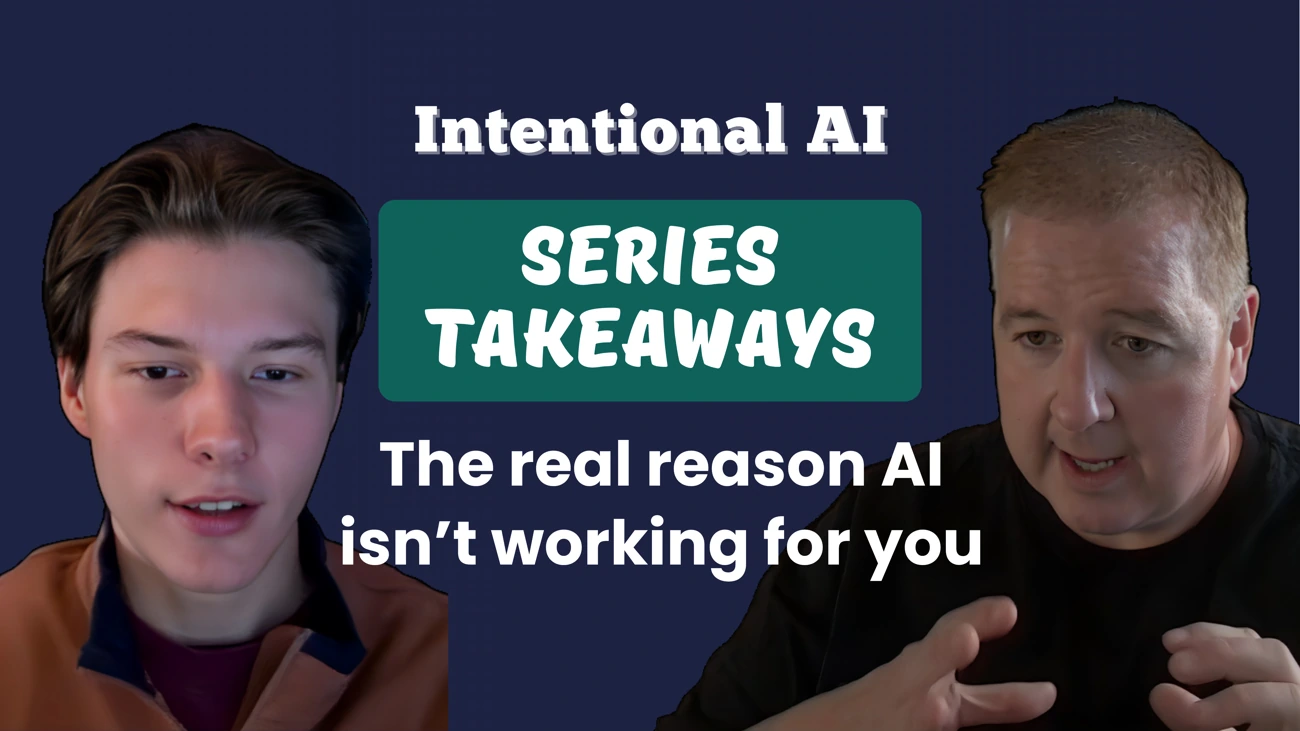
Intentional AI: Series takeaways - the real reason AI isn't working for you


Show Notes
Season 3 of the Intentional AI series started with a simple premise: AI is a powerful tool, but the way it gets marketed and the way most people actually use it are two very different things. Eighteen episodes later, that premise has held up.
In this finale, Virgil and Cole take stock of what the season actually taught them. Not the hype, not the headlines - what they observed firsthand through testing, building, and paying attention to how AI performs when real work is on the line.
A big part of this episode centers on a real-world example: Virgil's experience building an internal business application using an AI low-code tool called Zite. What made it work wasn't the tool. It was the month of planning that happened before a single line of code was written - database diagrams, stakeholder conversations, process mapping, all of it done before AI touched anything. The app ended up replacing four SaaS systems. That kind of result doesn't come from letting AI lead. It comes from knowing exactly what you need before you ask AI for help.
The flip side of that shows up in a small but telling moment: a teenager at the gym using AI to generate a workout plan. It probably gave him something reasonable. But here's the problem - he won't know whether it worked for three to six months, and he likely has no framework to evaluate it either way. That's the same trap organizations fall into when they hand big process decisions to AI without the expertise to judge the output.
Cole frames it simply: AI is a mirror. Whatever you bring to it, it reflects back. Strong process knowledge, clear goals, and domain expertise get amplified. Gaps and blind spots get amplified too. The tool doesn't know the difference.
Virgil runs through where AI held up the most across the season - SEO, analytics, research, coding, wireframes - and where it didn't, including original content, image generation, video, and design. Eighteen episodes in, the picture is a lot clearer than when we started.
Previously in the Intentional AI series:
- Episode 1: Intentional AI and the Content Lifecycle
- Episode 2: Maximizing AI for Research and Analysis
- Episode 3: Smarter Content Creation with AI
- Episode 4: The role of AI in content management
- Episode 5: How much can you trust AI for accessibility
- Episode 6: You’re asking AI to solve the wrong problems for SEO, GEO, and AEO
- Episode 7: Why AI can make your content personalization worse
- Episode 8: The real value of AI wireframes is NOT the wireframes
- Episode 9: Just because AI can create images doesn't mean you should use them
- Episode 10: The Super Bowl didn't sell AI, it exposed it
- Episode 11: AI video rewards planning, not your ideas
- Episode 12: AI might struggle with creativity, but coding isn't creative
- Episode 13.1: What the rise of conversational search means for your website
- Episode 14: AI agents are only as good as your workflow
- Episode 15: AI can't fix your social media if you have nothing to say
- Episode 16: The most important operation in analytics - understanding your "why?"
- Episode 17: How to get better results from AI prompts
That's a wrap on Season 3. Thanks for coming along for the ride - see you in Season 4!
For more conversations about AI, design, and digital strategy, visit https://www.highmonkey.com/podcast and subscribe on your favorite podcast platform.
(0:00) - Intro
(1:15) - Season 3 milestone: 2,000 listeners
(2:06) - Why we started this series
(3:09) - The AI backlash: justified or not?
(6:33) - Virgil's AI-built internal app
(7:29) - AI is only as powerful as the person using it
(9:56) - AI at the gym!
(13:00) - The workout is a microcosm of how AI gets misused
(15:24) - AI's real value: saving time
(16:42) - Plan first, build second
(21:04) - Security: the thing low-code builders miss
(24:59) - AI is a mirror: it reflects what you bring to it
(25:32) - Where we would use AI
(28:07) - Cheers to Season 3 + what's next
(28:48) - Outro
Subscribe for email updates on our website:
https://www.discussingstupid.com/
Watch us on YouTube:
https://www.youtube.com/@discussingstupid
Listen on Apple Podcasts, Spotify, or Soundcloud:
https://open.spotify.com/show/0c47grVFmXk1cco63QioHp?si=87dbb37a4ca441c0
https://soundcloud.com/discussing-stupid
Check Us Out on Socials:
https://www.linkedin.com/company/discussing-stupid
https://www.instagram.com/discussingstupid/
Transcript
VIRGIL 0:00
Well, 18 episodes later, we finally got here, and we're at the finale. If you've enjoyed this journey and learned a lot, we're going to talk a lot about what it meant, some of the challenges that we still see that AI faces, and what are some of the things you can do and how to really be successful with AI. So if that interests you, join us as we start discussing stupid.
VIRGIL 0:35
Well, after 18 episodes, we're here in the finale, and what an interesting ride this has been. I mean, I can honestly say that if I could have predicted, Cole, at the beginning of this series, that I was going to learn as much as I did, that I didn't know about AI that I thought I did - it kind of goes to probably one of the core things that I've learned through all the years of my life, which is that you're constantly learning. And now with AI, what you learn today, you need to change the way you learn tomorrow. So it's kind of that crazy thing. But anyway, we're here, we're done. This is it. Are we going to do this?
COLE 1:18
Well, first off, quick shout out to the listeners of this season. We have, for season three, broken 2,000 total listeners. So that's a cool little milestone here.
VIRGIL 1:30
Really cool.
COLE 1:31
Yeah. So thanks, everyone, for tuning in. This has been a lot of fun. I think we started back in, like, October.
VIRGIL 1:35
Pretty good time to plug that. If you're at all interested in seeing our faces, you can also watch us on YouTube and we have the full video version of it where you can see our smiling faces and everything.
COLE 1:46
Indeed. And yeah, we do go beyond the audio file here.
VIRGIL 1:54
Yeah, beyond is probably just, you can see our faces. And you can see how much my hands move.
COLE 2:00
Yeah, yeah, that's fun.
VIRGIL 2:02
That's probably about it.
COLE 2:04
Yeah. But I mean, so you talked about, you know, we've learned a lot over the course of this series, but at the same time, like, the whole reason we started the series is we recognized a lot of the hype going on with, you know, kind of the AI culture - some may call it like a cult even. But yeah, so we've learned a lot over the course of the series, but we've kind of confirmed a lot of the initial reasons why we wanted to start the series in the first place, which is you can't just, like, you know, turn your brain off, give it to AI, and have it do your work for you. That's kind of one of the main things that we wanted to explore over the course of the series, and we confirmed it over all episodes. And we established a lot of important things to keep in mind in using AI, because it's indeed a very powerful technology that you can leverage in your operation. But yeah, the way it's marketed has always kind of struck us in a bit of a weird way.
VIRGIL 3:13
Well, it's funny because definitely over the last few episodes, we've kind of talked a lot about the backlash that is happening right now around AI. And some of it is just because it's not meeting expectations, and not 100% AI's fault. It's probably a little bit a lot the people too. But you're right, it goes around the marketing. But the other thing is, commencement speakers are being booed at graduations that are mentioning AI as the future. We have all the security issues that are coming across. I know we're going to talk a little bit about what happened with Meta and Instagram, which just kind of makes me laugh. And then you've kind of got this whole thing with the data centers, the big controversy around the data centers and everybody - all these companies wanting to build data centers. And then on the flip side, you have a lot of these AI companies going public and basically some of the largest valuations ever. So you've kind of got this yin and yang, these two opposite sides that, instead of maybe balancing one another, are very much fighting one another about what AI really brings to the table and what our future is. But the only thing I can tell you for a fact is it's part of our future now, whether we'll go on to the Matrix level and eventually they'll be our overlords, or whether we'll literally never have to work again because AI will do everything. I can't totally tell you. It's going to be somewhere in the middle. To me, there's a lot of hubris in the people that work in the AI industry that don't seem to care about boundaries. But at the same time, there's also a lot of expectations that are completely unrealistic, which is why we started this series - because we wanted to be intentional about AI. If you use it intentionally for smaller pieces, it can do a lot for you.
COLE 5:18
Yeah, I agree with all you just said. I think the backlash is largely justified, especially when we're talking about being someone who graduated recently and you're entering the work world, and all of a sudden there's this technology that's pretty much threatening your degree that you just worked super hard for and your life as an employee in general. And it's like, yeah, that's scary. And also the data centers, and locals in these small towns are like, what the heck, my electricity bill has gone up so much. Anyways, yeah, the backlash is justified on those fronts and then also from a security and practical usage standpoint as well.
VIRGIL 6:15
That said, I think we can definitely take lessons learned from what we did. And I know our last episode we talked about prompts themselves, but I think the one thing I've learned - and you and I can go back to this - is that I've been building an internal application for our organization through an AI system called Zite. And I've been really blown away with what it's done for me. I've been able to replace basically four SaaS systems that we've used, and some spreadsheets, to do a lot of different functions for us. But I always go back to the conversation you and Seth had about it. And I agree with what you said. The reason it worked is because it was me, and I know how to code, I know how to build out a database, I know how to create business logic and understand the functionality I need around a system. But I think it also goes one more step further. AI is kind of as powerful as the person that is actually using it. So if you have an understanding of what you're trying to do, it's going to be so much more effective. But I think on top of that, it's our processes - the processes that we replicated into the system and made better. We know these processes really, really well. As a matter of fact, there's only one piece we still have to build out, and that's because that's the system where we're trying to create new processes. Instead of going crazy and building this massive system around it, we're doing that stage by stage, piece by piece. And I think that's really critical. A key to success is not only that you have knowledge around what you're trying to do - and that's the problem. A lot of people using AI are using it to fill gaps of things they don't know, and while that is a worthy cause, the problem is that also means you don't know whether what AI gives back, what it builds or recommends, is actually good. And that is a big problem. The other thing is, you're also trying to get it to replace processes that maybe you have no knowledge about. So what we're seeing is that if you understand what you want and you understand the processes to get there, you can legitimately get AI to help you out with it.
COLE 9:16
Yeah, which is where this development of this tool comes in - using Zite, the software we're using to replace, I think we've narrowed down from like four software-as-a-service tools. Our process knowledge has been there at each step, and even as we're building out our next processes, we're keeping that in mind. So we know that's going to be a successful operation because of that. But there are plenty of examples out in the real world where that's just not happening with AI, and that's where the return on investment is just not really seen. A very small-scale example that I really like - you brought it up yesterday. I believe you were at the gym and you overheard a young man talking about how AI made his workout plan for him. Do you want to talk a little bit about that?
VIRGIL 10:11
Yeah, you know, I always laugh at the random things. I even ran into a person I used to work with a long time ago and they were like, I've got ChatGPT on my phone and I use it, and boy, I ask it a question and it gives me an answer - and she was so excited about that. But here in particular I'm seeing more and more people talk about using AI to build workouts and that kind of stuff. I didn't stop and talk to those kids - I kind of laughed as I walked past. But I would have loved to stop and say, so how do you know that that's what you need? Because anybody that knows anything about lifting knows different things work for different body types, different activities work for different things, everybody has different goals. So I have no idea what this person put into figuring this out, but I'm just going to stereotype and say, since it was a teenager, it was probably like, I want to get washboard abs, create me a workout. But that's kind of one of the things that also speaks to the backlash happening around AI right now - it's not necessarily the tools. It's not that the tools can do everything. We've shown throughout a lot of our episodes that when you want the tool to be creative and give you original content, it's just not very good at it. It's good at taking what's there, analyzing it, and doing something with it. So that's why you use it for images, video, content, and you get results. But if you want something specific, you never get that specific result.
COLE 12:10
Yeah. And I mean, to be fair, with the example of that kid at the gym, it probably generated him a workout that was fine. But the issue that I see with that is, that is an example of maybe finding some success with AI - maybe he does get those washboard abs, I don't know. But then you're kind of training your brain to depend on AI for more and more. It's kind of like, once you give people a certain powerful technology, they're not very likely going to just be like, I don't want to use that anymore. So what in the future might someone depend on it for if they started by asking AI to generate a workout? And then what if you're not an expert on that and you can't evaluate the output?
VIRGIL 13:00
And that's the big thing right there. And you really nailed it. The reason we talk about this workout thing is because it really is a microcosm of what AI is like. So it created a workout. You are not going to know whether that was a good workout for three to six to nine months, or however long it's going to take you to actually develop those results. So six months from now, you may not still know whether it actually did any good. Well, that truthfully is the same as AI. If you're building out huge processes to make huge efficiencies in your organization, you're honestly not going to know whether that's doing anything for a very long period of time. Therefore, if you got it wrong six months ago - which is what's happening in a lot of organizations - they all implemented these things, they brought in the companies, they did all this stuff, and now they're like, well, this actually hasn't made work life much better. It really hasn't created efficiencies. And that's why we really - and I know people are sick of hearing it - focus on those small things. And honestly with the app, a lot of what we did is we replicated, and improved, but we replicated a lot of what we saw in the SaaS systems that we liked. We had used those processes for years and we knew that they worked for the way we wanted to work. What was missing was all that information connected together to be one complete system, which is what we really did. Now we've made some improvements to fit more our way of working, but overall it's just amazing. And again, it's a known process. It's something we really know. It's taking something that's been proven and pushing it into there, versus what a lot of people are doing with AI, which is trying something new and then honestly not being sure if the results are actually good, and biting off more than they can chew. And then in the end they're like, well, that didn't do what I wanted. Well, the reality is you didn't give it an opportunity to do what you wanted because you didn't have your side figured out.
COLE 15:23
Because at the end of the day, with this tool that you've built, Virgil, you and the rest of our High Monkey team, we probably could have built it. But the reason we use AI is to save time. Everything was defined up front. And yes, AI assisted in some of the planning, but you were still steering the ship, and you saved time. And that is really where AI comes in handy. That's probably my biggest takeaway of the series - if you're using AI to automate a process where time is your enemy, that's where it shines.
VIRGIL 16:08
Yeah, and everybody's going to roll their eyes at that. But I just had a conversation the other day with a young man that is trying to build an app, and he's looking for somebody to mentor him on the business side. One of the things I talked to him about is he kind of built this first version of his app and it didn't go well. He spent so much time trying to add new features and new things, he never really went back and looked at what he was doing. And that's so typical of what happens with almost anything. So one of the pieces of advice I gave is: before I even did this, it took me three months to get this app in place. The first month, literally, what was I doing? I was building a database diagram. I was mapping out all the functionality we wanted for the different components. I was having meetings with Cole and Seth, talking about the different things. I was talking with Chad and other people about these different pieces and what they'd want. We were looking at all our different pieces and really saying what we like, what we don't like. So I literally spent a month on that before I even started doing anything. So when we got there, I had a good plan and had a lot of success. Now, one of the things that Zite does really well - that a lot of AI tools don't necessarily do upfront - is you have three different modes. You pay per credit for using this tool. They have a chat where you can ask questions and talk to it, kind of say, how can I do this functionality, what would you recommend? So I had a lot of conversations with it as I was planning this out. And then it has a plan mode. And this is what I love. I can say exactly what I want to do and put it in plan mode. Instead of building it, it actually builds out the entire plan - tells me exactly how it's going to build everything, what assumptions it's making, what changes it's not going to do, features it's not going to add because I didn't ask for it. And I read through that, and that's where my knowledge really comes through - not only of building, but also of our processes - to go through this plan step by step and say, nope, I want this different, or nope, I didn't think about that. I've made so many adjustments to the plan at that stage that when I build, I feel highly confident that if it does what the plan said, it will build what I want. And I can tell you that 99.9% of the time it has done everything exactly like I wanted it. It's been about 0.1% where it didn't. And one of the funniest things is I had two columns that I needed to switch the order of on a table, and for some reason it just wouldn't do that. It was such a stupid little thing. But I was able to go into the JavaScript code and do that myself. But that right there is kind of a microcosm of how you should use AI in the first place. Use it to help you figure out what you need to do, and what its capabilities are. Use it to help plan it out and make sure it has a good understanding, and that if it uses this understanding, it will build or do exactly what you want. That is actually a perfect way to use AI.
COLE 19:30
Yeah, that planning feature - obviously not all tools have that exact system in place - but yeah, you should be seeking that before it produces output.
VIRGIL 19:41
You could use them all that way.
COLE 19:44
You could. I mean, if you're talking to the AI in a specific way where, like, that's what you're seeking before it produces output - like, reflect back what you're trying to do - that's kind of harder to do without the system in place, but still, that's a pretty powerful feature.
VIRGIL 20:03
It is. And yeah, one of the reasons it has those three tiers is because you're paying per credit, so you use fewer credits to chat, a little bit more to plan, and then most of them to build, because it switches between models and has access to all these models. But the reality is, that's another thing that's happening with AI - that's where everybody's going. I give it another year, maybe another year and a half, and almost everybody's going to be paying by credit rather than having unlimited AI. So it's the point of using smart. But now one of our other points we wanted to make - and if the people at Zite hear this, they're going to close this loophole - is around security. Zite would be considered a low-code builder. You use AI, you can do things in low code, you don't have to code yourself. You know, the GenSparks, the Lovables, all those - they've all been getting a very bad rap because they're building code that is security-vulnerable, and people are launching these apps on public things and they're easy to hack. So Zite did a really great job of building my app, but it didn't do such an awesome job of making it highly secure for what we needed. So I actually worked with it and had it do security checks. Out of all of its calls to the database and that kind of stuff, I found issues that needed to be addressed. The other thing it didn't do well is that a lot of our interfaces are very similar to one another - the way we show tables, the way we show tabs, the way we show lists, the way we show our project timelines versus our scrum board - and it did those all differently with different code. So I worked with it a lot over time to clean that up and centralize it. And now with every plan I put together, I say: make sure you follow best security practices, follow the layout and styling and functionality methods that currently exist in the environment. And it's done a better job, but not perfect. So that's something I regularly do, and that's a big thing around AI - as people start using it to build apps, they're not really thinking about the ramifications. A lot of people are sharing, for example, they're using ChatGPT and saying, here's all our company documents, our strategic plan for the next 20 years - please create me a report on that. Well, that's great, but at the same time you just provided it to ChatGPT and OpenAI and anybody that has access to that stuff - all your company secrets. People just aren't really thinking about that. And we laugh because we heard about Meta AI. Hackers were able to figure out how to hack into high-profile Instagram accounts. How? By asking Meta AI how to hack into those Instagram accounts. And it gave them the answer. I mean, how ridiculous is that? You have to also be cautious on that side.
COLE 23:32
Yeah, if only Meta had taken the same precautions that you did in Zite.
VIRGIL 23:38
Well, I'm not going to say I was perfect. But it's an internal system - you can't get to it unless you are in our account in Zite. So that's there. And I had some good discussions about their account security, but nonetheless it's still something you want to address. It's both sides. But again, this goes back to what we said originally. It's you understanding things and understanding what needs to happen. Low code is such an awesome concept to think about, but the reality is, if you're getting AI to build stuff for you and you don't understand the security issues around that, or the performance issues, or how to make it accessible for people in your organization that have accessibility challenges - all those things have to come into play and you have to be thinking about them as part of the process. That's where the knowledge and understanding of your processes and the understanding of the build process itself is critical. So those types of tools are going to be very valuable for people that have developer or highly technical mindsets. But for business people, which is who it's marketed to, you're potentially creating something that's going to be a complete mess somewhere down the road.
COLE 25:05
The way I like to think about it is AI is kind of a mirror. Whatever you bring to it, it's going to kind of reflect that back at you. And we're not quite at the point yet - at least in our testing over the course of the series - where it's going to really push back or give you your blind spots. I mean, unless you really integrate that into your pre-prompting and whatnot. It'll probably just confirm what you're saying.
VIRGIL 25:36
So yeah, I mean, let's look at all of our episodes - what are the things that we would legitimately use AI for? Well, I think a lot of the SEO stuff we did, it's legitimate, it can help you out with that. Looking at analytics, it's very good at that. Doing research, going through massive amounts of information, it can do that - we probably wish we would have asked it better questions and given it more parameters on the original research of the article, but from there it was solid. Search is another powerful piece. Coding, another powerful piece. Wireframes - it did a pretty good job. It doesn't necessarily make it very usable for us to manage, but it can get you there. And I just used it recently to help me build out an information architecture diagram. So there are things, but it's all things that I'm able to easily put parameters around and it can come back with logical information. Where I wouldn't use it - I still would not use it to generate original content. I might use it to give me content ideas, but I would never use it to generate an original image unless I really didn't care what the image looked like, which is a lot of what people use it for because they don't care, they just want some graphic out there. Video, I wouldn't use it for that stuff even if you sat there and storyboarded it forever. So there are these balances of where it's going to be very effective and where it's not. Design - it did a disaster in design, I think. I mean it was very boring and monotonous and it just made it look like a million other apps instead of a unique design that a web designer would create.
COLE 27:28
Like, design is kind of pattern-based, like UX. A lot of times it should follow a predictable pattern model. You should be able to know where you're probably going to find certain types of information and certain types of access points. But at the same time, you're very much sacrificing originality when you depend on AI for a design or visual-based output.
VIRGIL 28:00
And it comes down to using AI intentionally, using it for good purposes, using it for specific purposes.
VIRGIL 28:15
We sure thank everybody for joining us on the journey of season three. We have a lot of exciting ideas already for season four. Hopefully going to launch that late September, early October. We'll kind of see when we get to that. And we might be launching a few tidbits over the summer - some micro episodes that we've been talking about doing. We might take a short break and then start releasing those maybe towards the end of July or something. Just some little bite-sized tips that we can give - little practical, few-minute, here's-how-to-do-something type of things.
COLE 28:54
Right on.
VIRGIL 28:55
Thank you everybody for joining us and have a great summer. Just a reminder, we'll be dropping new episodes every two weeks. If you enjoyed the discussion today, we would appreciate it if you hit the like button and leave us a review or comment below. And to listen to past episodes or be notified when future episodes are released, visit our website at www.discussingstupid.com and sign up for our email updates. Not only will we share when each new episode drops, but also we'll be including a ton of good content to help you in discussing stupid in your own organization. Of course, you can also follow us on YouTube, Apple Podcasts, Spotify, or SoundCloud, or really any of the other podcast platforms you might use. Thanks again for joining and we'll see you next time.
Latest Episodes
Season 4: The Teaser
Intentional AI: Series takeaways - the real reason AI isn't working for you
Intentional AI: How to get better results from AI prompts
Sign up for Discussing Stupid updates
Get the latest Discussing Stupid episodes, expert insights, and exclusive content- straight to your inbox