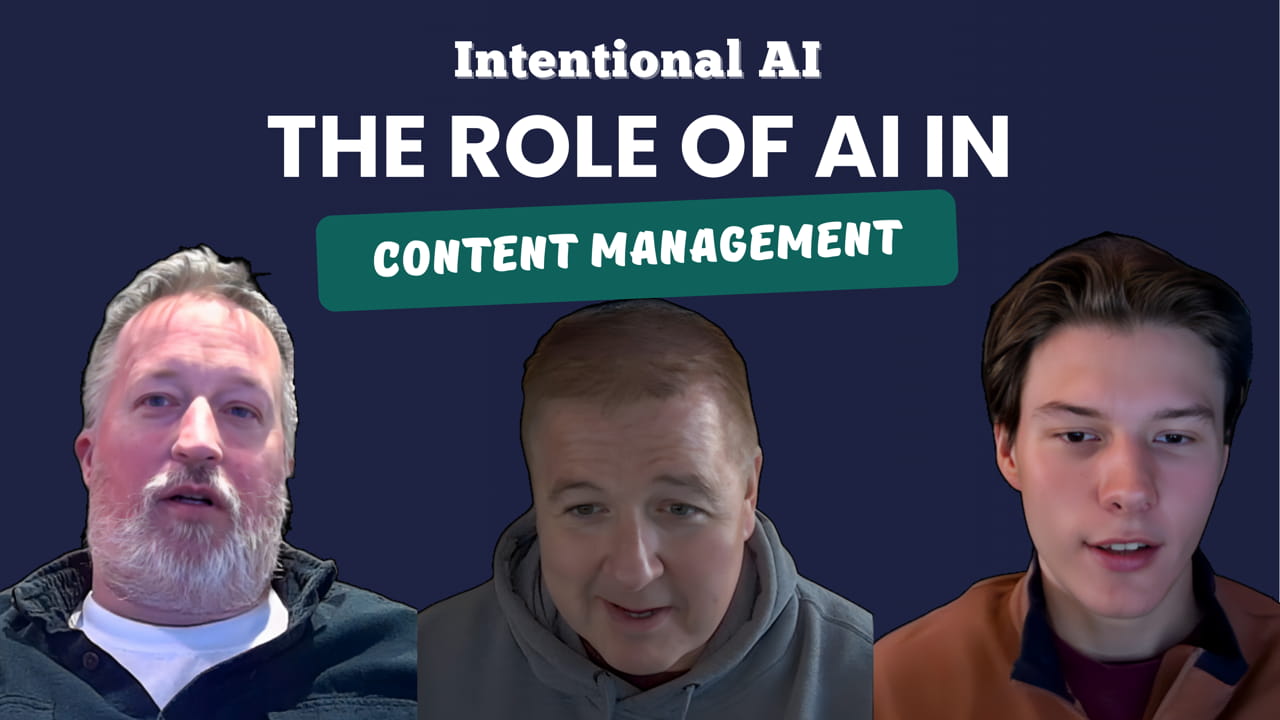
Intentional AI: The role of AI in content management


Show Notes
Once your content’s written, the real work begins. Editing, organizing, translating, tagging, all the behind-the-scenes steps that keep content consistent and usable. In this episode, the team looks at how AI can help streamline those tasks and where it still creates new challenges.
Joined by returning guest Chad, they break down where AI fits, where it fails, and what happens when you trust it to translate complex content on its own.
In this episode, they explore:
- How AI supports the content management stage of the lifecycle
- Common use cases like translation, auto-summary fields, and accessibility checks
- Where automation makes sense and where it doesn’t
- The biggest risks of AI content management, from oversimplification to data privacy
- Why good input (clear, readable content) still determines good output
- How readable, accessible writing improves both human and AI understanding
This episode also continues the real-world experiment from previous episodes.
Using the accessibility article originally created with Writesonic, the team tests how well three AI tools: Google Translate, DeepL, and ChatGPT, handle translating the piece into Spanish. The results reveal major differences in accuracy, tone, and overall usability across each model.
A downloadable Episode Companion Guide is available below. It includes key takeaways, tool comparisons, and practical advice for using AI in the content management stage.
🦃 Note: We’re taking a short Thanksgiving break, the next episode will drop on December 2, 2025.
Upcoming episodes in the Intentional AI series:
- Dec 2, 2025 — Accessibility
- Dec 16, 2025 — SEO / AEO / GEO
- Jan 6, 2026 — Content Personalization
- Jan 20, 2026 — Front End Development & Wireframing
- Feb 3, 2026 — Design & Media
- Feb 17, 2026 — Back End Development
- Mar 3, 2026 — Conversational Search (with special guest!)
- Mar 17, 2026 — Chatbots & Agentic AI
- Mar 31, 2026 — Series Finale & Tool Review
Whether you’re managing websites, content workflows, or entire digital ecosystems, this conversation is about using AI intentionally, to work smarter without losing the human judgment that keeps content trustworthy.
New episodes every other Tuesday.
Chapters
(0:00) - Intro
(0:50) - Today's focus: Content management with AI
(1:58) - Content management opportunities with AI
(6:18) - Recurring series theme: Trust
(8:34) - Refine your process one step at a time
(9:53) - Better content = better everything
(10:22) - We tested 3 AI translation tools
(12:02) - Cole's "elephant in the room" test
(14:28) - Poor content = poor translations
(16:58) - True translation happens between people
(18:45) - Closing takeaways
Subscribe for email updates on our website:
https://www.discussingstupid.com/
Watch us on YouTube:
https://www.youtube.com/@discussingstupid
Listen on Apple Podcasts, Spotify, or Soundcloud:
https://open.spotify.com/show/0c47grVFmXk1cco63QioHp?si=87dbb37a4ca441c0
https://soundcloud.com/discussing-stupid
Check Us Out on Socials:
https://www.linkedin.com/company/discussing-stupid
https://www.instagram.com/discussingstupid/
Transcript
VIRGIL 0:00
After you've written your content, that's kind of when the work just begins. Next comes editing, then organizing it, and maybe even translating it. AI can help with some of that, but you still have to use your brain in the process. So if you want to learn more about that, join us as we start discussing stupid. Hi, everybody, and welcome back to the podcast. We have somebody joining us again for the first time this season. Welcome back, Chad.
CHAD 0:41
Thank you for having me.
COLE 0:42
Yeah, Chad.
VIRGIL 0:44
Yeah, So we brought in Chad because we're going to be talking about AI and content management today. So Cole, why don't you go ahead and kick us off?
COLE 0:58
so as far as we're at in the series, contextually, we just, the episode before, had some content created with an AI tool. And then today we thought of, taking that content to the next stage of like, what happens after you make the content. So imagine you're like, you know, you've created an article and you got to get it published, but there's a lot of steps you got to do. Before getting to that point, before getting into the CMS, like you might need to check your readability, might need to polish the tone on it a bit, add metadata, might even need to like summarize it for someone else. But so we're kind of talking about AI's role in helping do a lot of those automated repetitive tasks. So that's kind of what today's episode is about. So what are some of those those risks involved with this process, though. Can you guys speak to any of those to start off?
VIRGIL 1:58
Well, I mean, I think from the standpoint of, kind of opportunities, to me, content management, and that's why actually the next several episodes are going to be kind of fitting more of that your content's created, kind of what we need to do after it. Content management is such an exciting area. that you can do so many things. And I think that a lot of people, like we said before, are kind of leaning towards using AI for research and using AI for content creation, when probably one of its better strengths is taking what you've done and helping you maybe improve it or manage it and that. So I think there's a lot of different areas that kind of go into what content management really is. But I think some of the most exciting things are around process automation. I think that's a huge one where you think of, right now, in a typical CMS, we have someone that is, they created some content, they've submitted it for approval. Maybe there's a two, three, four, five-step workflow where it goes to somebody else, they review it, maybe it's a subject matter expert. Maybe it's an approver, maybe it's a business leader, whatever it is, and they go back to edits and they kind of go back and forth from there. Now imagine that you could get AI to be smart enough to sit there and say, okay, it submits it to the AI and the AI looks and it looks at your voice and says, does this match the voice of the site? Does it match other criteria like, is it fully accessible? Did they tag all the images? Did they do that kind of stuff? Are there all those different pieces that they could be doing in there from there? So it's such a great opportunity to think about it. And then if it's all there, maybe then it gets auto-published. And this is an area that we're seeing in a lot of CMSs that they're starting to bring forward, right, Chad?
CHAD 3:56
Yeah, and it's exciting because that that process can be such a bottleneck. if you're, if you're especially in a multi-step approval, if somebody's out for the day, that subject matter expert is out for the day, if a manager's out for the day, you can get a backlog of content that you wanted to get out there but can't get pushed through. And it's, I think, too, There's different levels of editors out there. I think we can all agree. And some of those that have been, maybe working with content for a long time and just really need a rubber stamp more so than a thorough review of their content. Like somebody new needs that thorough review, but the person that's been there just needs a quick check on everything. I think there's a lot of opportunity there.
COLE 5:02
Yeah.
VIRGIL 5:02
no, I think that you're right. I think this isn't necessarily a one-size-fits-all. And so when you talk about the risk hole from there is what happens if it publishes something that you didn't want published or didn't meet your standards or, you know, had something wrong with it. I mean, you know, there's limitations to AI. So I think Chad brings up a good example of how you could maybe you have certain authors or certain people or certain areas that you feel like could go forward. Like, if your communications group is doing a press release, a press release has a very standard process to it. And, typically the press releases are going to be vetted before they'd ever be put on a website. So, you know, maybe that's something for automation where if you have somebody adding a new promo piece about a product or something, maybe that's something that you need more human intervention for. So you kind of have to make the decision on where to go there. But I mean, there's a lot of other processes inside there too that it really has the opportunity to help you out with, from, like you said, making things more readable, checking accessibility, translation, which happens to be what we're going to talk about here in a little bit. from that side. But again, it kind of goes back to, one thing people are probably going to either really like or get really sick of in this whole series is we kind of are going to keep hitting same themes, which it's about trust. it's about trusting the system to be able to do that and what it means. And I think that there's areas in which you can get it to kind of help you manage the content after content has been created. And there's just a lot of opportunities in there to kind of help automate those pieces. You know, you could think about a form, you know, I mean, we could probably think of a dozen scenarios, you know, where like, you know, somebody fills out a contact form. could the AI be smart enough that it could look at what the form was and actually direct it to the right person based off what the question the person asked or where they're from or that kind of stuff. Look into a CRM and see that this is, you know, Larry's customer and routed to Larry and that kind of stuff.
COLE 7:20
And even in that type of scenario, though, don't you still want some level of like oversight, like someone to approve it at least? Or are we like past that at this point when it comes to like the content management?
CHAD 7:34
I think that's the trust that Virgil is talking about there. How much, you know, how easy is it for AI to understand your content, how easy is it, how reliable is it to get it right? Is it simple? Maybe you trust it more with the simple stuff and you have to review the more complex stuff. Is it just kind of, you know, is it a biography about somebody? Is it technical specifications about your manufacturing product? you're probably going to want, a spot check on the bio, but some subject matter experts are going to need to review those technical specifications. So there's a wide range there about what it might handle better than other things.
COLE 8:26
Yeah.
VIRGIL 8:27
And so one of the things I had, you know, when you and I were talking the other day, Cole, that I mentioned is that, you know, a lot of times what you need to think of in this area is much like honestly, the way when I used to program, when I used to do that stuff, I did for a long time in there. And that is, you get it, you look at one piece it can help with, and you get that working, and then you look at the next piece, and then you look at the next piece. And too many times people want to try and bite off the whole process at once. and do that from there. And so the problem really is that people try to do too much. it's just like a general workflow or anything like that. Everybody wants it to do everything instead of just getting it to do one piece well. And so maybe, one piece you want is making it more readable. Maybe one piece you want is evaluating a form. Maybe one piece you want is just determining did they meet these five criteria when they submitted their content. So, when you have five different things, things that are manageable, you get that to work right, then start looking at adding the fancy in there. But the biggest pitfall people are going to run into is they're just going to try to do it all at once and way too fast. And, you know, we're going to keep saying it and not actually check their work.
COLE 9:54
Well, it seems like, you know, however many processes you're trying to automate and stuff, the better you start off with your content and the more clear it is, and I guess the more intention there is behind your content and all things under that umbrella, you're just going to have a better time trying to automate the rest of the processes.
VIRGIL 10:17
I see what you did there, Cole, really transitioning into our test. So, before the test, we decided to test the translation abilities of some AI tools and being a very typical task that people are using. I mean, this is kind of one of the big pushes in the AI world is getting it to translate. So we use that Writesonic article and. We had it translated. And we ended up using three tools. We tried a new tool that is really known for its translations, DeepL. And then we used Google Translate, which, you know, everybody's like, well, that's been around for a really long time, but, you know, it's been using AI for a long time as well. And then we used ChatGPT. And we had it translate the Writesonic article into Spanish. which is not a language I speak, nor I believe Chad speaks, but it is one that Cole happens to speak semi-fluently.
COLE 11:18
Yeah, I studied abroad.
VIRGIL 11:19
And so I was talking a little bit about some of your experience with that, because I think it's kind of funny when you told me about it.
COLE 11:28
Well, Virgil knows that I studied abroad in Spain like a few years ago. So he's like, hey, Cole, how about you examine some translations for this podcast episode? I was like, all right, yeah, let's do this thing, I guess. But yeah, I minored in Spanish, so take that for what it is in my evaluations of these translations. But yeah, should we just get started and take a look at them? All right, well, Taking a look at the first one here, ChatGPT, okay, first off, across all three articles, I looked at the same thing to start off. In our original Writesonic written article, we have, literally the first sentence is, digital accessibility barriers remain the elephant in the room for many businesses today. And I already knew, from my time in Spain, of course, that there's no translation to that phrase, an elephant in the room, because I tried to use it before over there and people were like, what are you talking about? But so in ChatGPT, they directly translated that phrase into the Spanish direct translation. And so I was like, oh, this translation can't be too good. And I did find a lot of other inconsistencies with the ChatGPT translation. in that kind of ballpark of incorrect translations and stuff. So yeah, I mean, obviously, though, ChatGPT is very convenient to use. It's a part of a lot of people's AI lives, but I just don't think this is probably the best route to go in terms of how translations.
VIRGIL 13:11
It's unbelievably slow. I mean, you know, when I use the three tools, I bet DeepL and Google Translate had the documents translated in a matter of five seconds or less, and ChatGPT took about 3 or 4 minutes to do it. But it doesn't surprise me. I mean, I think one of the problems with these tools in the 1st place is, will they translate? Sure. But will they translate context and meaning? And you're absolutely right. I mean, if our content is the way we kind of talk here in the US, with all of our slang in that, a lot of that doesn't translate well. And it's ironic because, I mean, it kind of goes back to that point. If your content sucks, when it's written for somebody with a rocket science level degree, it ends up translation's not going to happen very well. Yeah.
COLE 14:06
Well, that's kind of the interesting piece across the next two tools, DeepL and Google Translate. Like those two tools were able to take this first phrase and kind of apply the intended meaning to it, which was cool to see like that they were able to kind of take, go beyond the direct translation here. But regardless, we took this Writesonic article of ours that had a pretty tough reading level and tried to translate it across several tools and it just did not go well. So, you know, trying to do that in the 1st place is what I think the stupid practice that we discovered here.
VIRGIL 14:49
Yeah. I mean, Chad, Lord knows we never see anybody with poor quality content out there.
CHAD 14:58
Never, ever. No. Absolutely not.
VIRGIL 15:00
Yeah. So, I mean, that's kind of one of the things that you're going to have is it, you know, again, we're going to say it again. If you have poor quality content, a lot of $1,000,000 words in that content, it's just not going to translate well. But it also goes back to the side of, can you trust these translations? There's kind of a general mentality, especially here in the US, I think more probably than other countries, where we kind of think of, you know, what these translation engine being is good enough so it can convey the meaning in that. But you're almost doing a disservice to, people that English is a second language or to people from other cultures and that when you're basically saying, this is good enough for them to understand, that's all we really need them to do, versus them being able to read it natively, like somebody who's a native English speaker. So, you know, in our next episode, we're going to be talking about accessibility. And one of the things we're going to do there is we're actually trying to convert content into an 8th grade reading level. And that really ties into this because if something is at an 8th grade reading level, it should be a simple enough language that should actually translate really well. So you have that piece of it. And, you know, I know, Cole, you brought it up. Maybe we should have done the other episode 1st and then do that. But, you know, I mean, it's such an interesting thing.
COLE 16:31
honestly, I think the order that we did this is probably for the better, because we just exposed how terribly it goes when you try to translate content like this Writesonic article that could have used some 8th grade reading levelness to it.
VIRGIL 16:49
Yeah. But I mean, if you can use this for starting a translation process, so, you know, converting the words and that kind of stuff, The part that is probably the real big clincher is, do you have somebody that can tell you that this is? And I'll tell you, I've done this, and I'm sure a lot of people, other people do it, is they take what they get in translations, they put it back in something like Google Translate and have it translated back to English and see what it is. But it's not really a one-to-one type scenario because, you know, word order and everything else that happens in different languages compared to English is very different. So Again, it kind of goes to that trust and that need for that additional individual to kind of assist with it.
COLE 17:36
That's tough because you, obviously aren't always going to have someone who speaks both the translated language and the original language. It's kind of hard to come by, but I think as like a good practice, just making sure that your content is as clear as possible. That doesn't mean boring. You can still have, life to it, but like it's just kind of hard when you're trying to translate extremely complex content.
CHAD 18:07
I think, though, that middle step of having somebody, a native speaker, edit rather than generate the content, even if you have to then go to an outside service, you're still going to save time. So one of those, one of the biggest complaints, or I guess one of the biggest hurdles about complaint is that if you need an outside service that costs money, business can't afford it, so they don't do it. So I think if there's, if there's a way to make it easier, if there's a way to make it faster, more affordable, then maybe that's the good, maybe that's the positive step here for AI.
VIRGIL 18:46
and we talked about those process automations. I mean, you and I both know that a lot of CMSs now are including, translations as part of their, I mean, Kentico just released where you could do AI-based translations inside the content management system in that. And that's probably going to be a big thing. And I agree. I think you get them to be able to do that first step, which is going to save you time as long as you've got good content. But if you don't have good content, as Cole has kind of pointed out, it's not really going to save you any time. It's probably going to spend more time for you to actually make it all well and good.
COLE 19:27
People always think they're saving time with this stuff, but you just, I don't know, it loops back around somehow, right?
VIRGIL 19:35
Well, it goes back to what we talked about kind of during the introductory episode. AI doesn't get you around good best practices, doing things well. If you do things well throughout the process, there's a good chance that it can help you a lot. But if you're just sloppy and you're trying to use it to speed everything up, it's a good chance that you're going to get crap.
COLE 19:59
Indeed. Well, next episode, we will be getting into taking the same Writesonic article and getting it to an 8th grade reading level. And that's going to be a fun process. But thanks everyone for tuning in today for the Translation Chronicles. And shout out to Chad for coming back to the podcast.
CHAD 20:21
Thanks for having me. It's been fun.
COLE 20:23
Yeah.
VIRGIL 20:24
Thank you. Just a reminder, we'll be dropping new episodes every two weeks. If you enjoyed the discussion today, we would appreciate it if you hit the like button. and leave us a review or comment below. And to listen to past episodes or be notified when future episodes are released, visit our website at www.discussingstupid.com and sign up for our e-mail updates. Not only will we share when each new episode drops, but also we'll be including a ton of good content to help you in discussing stupid in your own organization. Of course, you can also follow us on YouTube, Apple Podcasts, Spotify, or SoundCloud, or really any of the other favorite podcast platforms we might use. Thanks again for joining, and we'll see you next time.
Latest Episodes
The new WCAG 2.2 rules you're already breaking (part 2)

The new WCAG 2.2 rules you're already breaking (part 1)
Season 4: The Teaser
Sign up for Discussing Stupid updates
Get the latest Discussing Stupid episodes, expert insights, and exclusive content- straight to your inbox