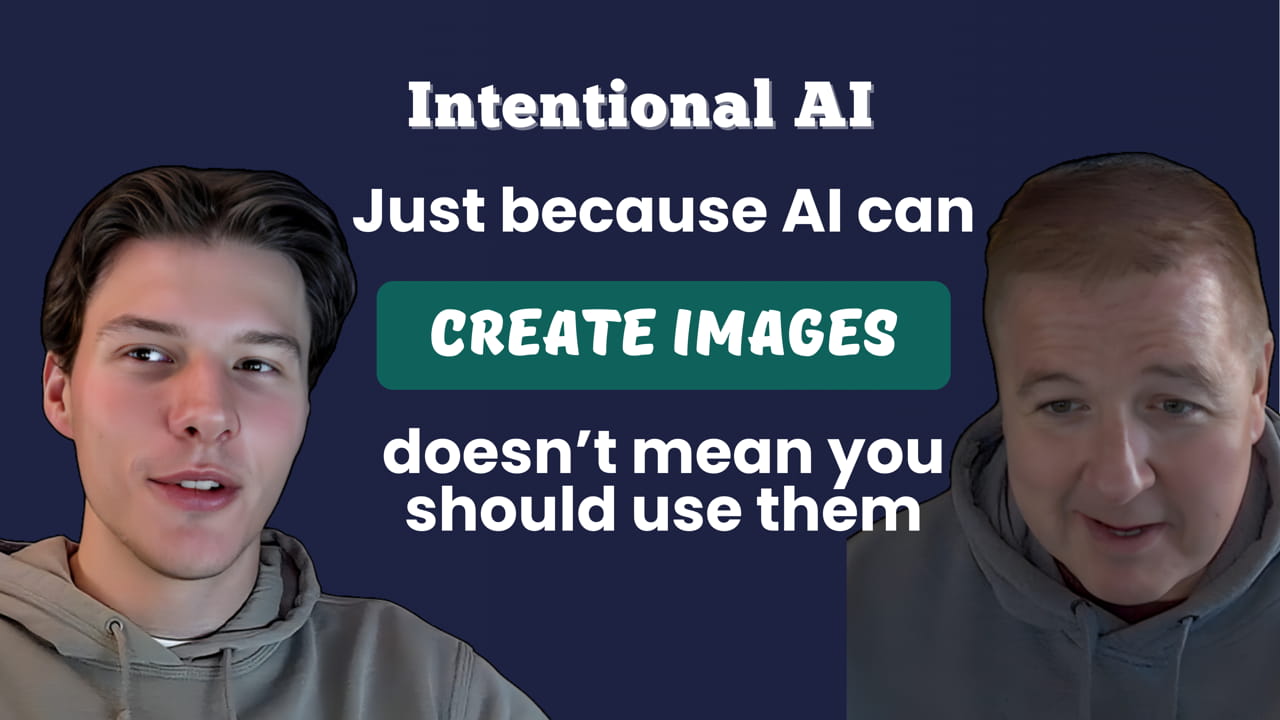
Intentional AI: Just because AI can create images doesn't mean you should use them


Show Notes
In Episode 9 of the Intentional AI series, Cole and Virgil take on one of the most common and misunderstood uses of AI today: image and graphic generation. From social media visuals to promotional graphics, AI images are fast, easy, and everywhere.
The conversation focuses on why images became the public on ramp to AI and why that familiarity creates risk. Visuals feel harmless, but the moment AI starts generating finished looking images, teams inherit decisions around ownership, ethics, and trust that they are often unprepared to make.
A central theme of the episode is responsibility escalation. As AI reduces the effort required to create images, the importance of human judgment increases. Treating AI generated visuals as final work can quickly introduce legal, ethical, and reputational problems.
Virgil shares a practical experiment where he used a simple prompt to generate three social media promotional graphics from an existing article and tested the results across three tools: Canva, Claude, and Artlist.
Canva produced the most generic and repetitive designs. Claude delivered cleaner structure and stronger messaging but struggled with fonts, formats, and variation. Artlist created the most visually interesting outputs, though it introduced workflow limitations and cost concerns.
The episode reinforces a consistent conclusion across the series. AI can help jumpstart visual work, but it cannot replace judgment, intent, or responsibility.
In this episode, they explore:
- Why AI images are so tempting to use
- Where AI generated graphics actually help
- Why most AI visuals fall flat
- Ethical and ownership risks teams overlook
- A comparison of Canva, Claude, and Artlist
A downloadable Episode Companion Guide is available below with example outputs and tool takeaways.
https://links.discussingstupid.com/s3e9companion
Previously in the Intentional AI series:
- Episode 1: Intentional AI and the Content Lifecycle
- Episode 2: Maximizing AI for Research and Analysis
- Episode 3: Smarter Content Creation with AI
- Episode 4: The role of AI in content management
- Episode 5: How much can you trust AI for accessibility
- Episode 6: You’re asking AI to solve the wrong problems for SEO, GEO, and AEO
- Episode 7: Why AI can make your content personalization worse
- Episode 8: The real value of AI wireframes is NOT the wireframes
New episodes every other Tuesday.
(0:00) - Intro
(1:40) - You can’t escape AI imagery
(3:18) - Why AI images are risky
(4:40) - The legal and ethical line
(6:15) - Creativity vs time and cost
(9:28) - Every tool has hopped on the AI bandwagon
(13:20) - The slippery slope of AI visuals
(15:35) - We tested 3 tools for AI visuals
(17:30) - Testing Canva
(20:40) - Testing Claude (Opus)
(22:15) - Testing Artlist
(24:15) - Tool testing takeaways
(26:45) - Closing thoughts
(28:00) - Outro
Subscribe for email updates on our website:
https://www.discussingstupid.com/
Watch us on YouTube:
https://www.youtube.com/@discussingstupid
Listen on Apple Podcasts, Spotify, or Soundcloud:
https://open.spotify.com/show/0c47grVFmXk1cco63QioHp?si=87dbb37a4ca441c0
https://soundcloud.com/discussing-stupid
Check Us Out on Socials:
https://www.linkedin.com/company/discussing-stupid
https://www.instagram.com/discussingstupid/
Transcript
VIRGIL 0:00
AI images are everywhere you look, and from a marketing perspective, they're incredibly tempting to use. But once they become part of your workflow, they can bring so many ethical, trust, and ownership questions most teams have never had to answer before. So just because you can use AI to create images, does that mean you should use AI to create images? If this is a hot topic you want to know more about, join us as we start discussing student. Hi, everybody. Welcome back to the podcast. Today we have a topic that. Well, we decided to break into two topics, probably more because of the controversial nature of the topics than maybe the benefit of the topics. But today, Cole, we're going to talk a little bit about images. Yeah, Graphic, right?
COLE 1:09
Yeah, just, you know, the visual stuff that AI puts out. And I guess, like last episode we did wireframes and layouts, so we kind of.
VIRGIL 1:16
I mean, obviously it'd be the natural thing. And so this episode we're going to talk about the kind of static side of it, which is, you know, the visual imagery in that. Graphics, you know, logos, that kind of stuff. And then the next one we're going to talk about motion. So videos, animations, audio, that kind of stuff.
COLE 1:39
Yeah, you know, I just thought it was funny because, you know, graphics, images, this is like, probably what people interact with the most when it comes to AI, you know, like scrolling through social media ads. Like, I know whenever I go through like, Amazon, like, all the images are that you see pretty much are just AI generated somehow. And so this is an interesting.
VIRGIL 2:04
Well, my social media feeds are always, you know, everybody's always got some kind of challenge going on, whether it's, you know, like, I remember my friends all were doing things where it was like a profile with a, A beautified picture of yourself alongside the, the like, stats about yourself or, you know, this, this last Christmas was very much about, you know, kind of the Foundry portrait is an. As a cartoon type of thing. But yeah, I mean, I, I would agree when you talk about AI, if, if people have had exposure in their everyday lives, probably the biggest chance is they're going to have to done something with images. And honestly, more for the novelty aspect than anything, you know, to see how fun it is and to be able to communicate and, you know, participate in a lot of these social experiments that people are doing.
COLE 3:00
Yeah. And I mean, all the, all the collective funding across the board of our economy that's going to AI, it seems like, is like all of it going into, like, Genmojis and these avatars and trends. Like, I don't Know, it kind of seems like.
VIRGIL 3:14
No, that's true, that's true.
COLE 3:16
But yeah, there's, there's definitely some, you know, pros to using AI in this department, and there's, there's obviously risks as well, so.
VIRGIL 3:25
Risk is probably an understatement, honestly.
COLE 3:28
Yeah, no, I mean, it's dangerous. It's really dangerous. This whole, this whole area of AI, you know, the whole defect thing, I mean, there's identity issues that are raised. You know, I mean, where do we even start with this?
VIRGIL 3:46
I, you know, I don't know that it's an easy topic to start. And obviously, hopefully, you know, the people that are listening in our audience are responsible business people and have kind of that business moral compass that you're looking for. But the reality is, even if you do, sometimes using the quick side of AI, it can give you costs. I mean, you, you look at things like deep fakes and, and things like that and, and the fundamentals of it behind the scenes, and you're looking at like, you know, people using the likeness of somebody else and changing it, taking a scene and making it something different. You know, combining images together to make them seem like one thing. I mean, these are all things that are very well known in the world of deep fakes in that. But the reality is there's a certain amount of this in the world of business as well. I mean, you know, people are taking images and, and bringing those together. And what happens if you don't own those images? So you're taking a person's picture that maybe you do have permission to use or maybe you don't have permission to use, and now you're having AI not only use it for something that maybe it wasn't originally used for, but also altering it, you know, so that now instead of the person standing still, they're shaking someone's hand, you know, or something like that. So from an ethical perspective, it's a very fine line. From a legal perspective, it's a very fine line of how you kind of do these type of things. And you know, the AI industry, that's what they tout is really the benefit is being able to do whatever and, you know, be able to do these kind of things when in reality you're potentially opening yourself up to a lot and possibly crossing boundaries that you don't want to cross.
COLE 5:43
Yeah, I mean, it sounds nice, like on the surface, you know, like being able to do this type of thing, but like, even putting aside like, the legal and ethical concerns, like, okay, let's say, and for Starters, I don't even, I don't think that AI generated images are, are very good usually at all. And like, okay, like I bet like in the future that they'll be like getting, you know, getting a lot better. But like, I don't think we even want them to be getting that much better because what are you replacing? Like, like, let's say like aimage generation gets like extremely good. Like I think the cost of that is just like human creativity that's like kind of, you know, what makes us human. It's one of the best parts.
VIRGIL 6:23
It's replacing time. Yeah, I mean that's really what it's all about in resources. I mean I, I 100 agree that human creativity should always be there, but the reality is, is human creativity costs money. I mean, you know, unless you happen to be the person that can do it yourself and you have the time to do it, you're, you know, you're, you're going to hire an agency, you're going to hire an outside service, you're going to hire a graphic designer on staff and all that. And that all has, has a cost to it, it has a timing. You know, if you have your own graphic designer inside your organization, somebody who can do these, or maybe somebody who's really efficient at using, you know, like Figma or Canva or something like that, that is more universal like that. You know, it takes time for them. If you have to work with an agency, you know, like say us or something like that, there's a lot of benefit from that. But the reality is there's the back and forth and there's a time that it takes to do it. A lot of people using these for things like social media posts and you know, quick little things for, for maybe articles they're, they're publishing or stuff like that. So there is a time element that, you know, I, I AI, I can build this image hopefully the way I want it to, in the time I want it to without having to interact with somebody else in there. And, and that to me is the big benefit of this because you know, obviously you and I have seen when it comes to the creativity side. Yeah. When you go out into those real fanciful, you know, kind of more sci fi ish looking images that we see everywhere, AI seems to do really good making something kind of fantastical in that. But the reality is who the hell's going to use that in their business literature, you know, unless you happen to be that kind of company. So I don't know that it has as Practical of application there. But I do fundamentally understand from a business perspective it's, it's about time and resources sometimes and if you need something dirty, maybe you do something that can.
COLE 8:30
Do that fast that, I mean, yeah, that makes sense. I think this is where you find that like, I mean in pretty much all our episodes we talk about like finding like a happy medium between like, you know, full on human labor and then like leveraging AI. I think this is an area where you really have to be conscious of that. And in the wireframing episode that we just did, we talked about how it's a really great tool for like jump starting the process of wireframing AI. You know, AI is, and I think this is, you know, probably another instance too where AI is useful for like, you know, getting that process going. It can come up with like some ideas for you in terms of like creating a graphic, maybe even like starting the first parts of it. I know Canva has a great tool for AI or AI embedded into its tool, but yeah, so.
VIRGIL 9:19
Well, you know, you talk about canva, here's the thing that I laugh at and I don't want to go too far down this path, but this is just one of those things about kind of the AI trend in the first place is every tool has it now they have their own AI tool. And it's just so nonsensical. I mean, you know, from what you can do. I mean, you know, obviously in the wireframing one we tried using Figma, which you know, did a good job of building wireframe. But then, you know, their images, you know, who knows where those came from and that, because those were some of the craziest looking images in there. But you have all these tools and everybody's plugging it in there. And this is one of the problems, I mean this has been a problem in technology for so long is that everybody wants to do their own thing. And from the end user, that's so frustrating because it's like, what tool do you go to? I mean, honestly, that's one of the biggest points of our entire series is saying there's 500 flipping tools out there. Which one do you use? Well, they all do something usually pretty good and they all do something pretty bad, but the reality is none of them meet that need. Well, you know, there's ones that are better, but I mean, I mean that, that's part of it is, you know, I, I, I mean obviously, you know, we, we tested CANVA for this and I thought canvas AI was kind of crap. It Wasn't, it wasn't very friendly. It, it didn't do a very good job with everything. And considering that Canva is the most ubiquitous, you know, kind of marketing graphical literature tool probably out there on the market, it's kind of funny that their AI not all that great. Yeah, my opinion. I mean, in my professional opinion, not.
COLE 11:11
All this is, you know, a comforting dialogue. There's all these tools out there and just none of them are, none of.
VIRGIL 11:17
Them are very good. Yeah, well, I mean, very good. Look at the backlash that's happened to the big dogs, you know, the, the, the Copilots, the ChatGPTs, the, the, the Claudes and all them. I mean, all of them have major flaws in the way they do things. I mean, you know, from psychedelic conversations to, you know, providing false information, to, you know, being manipulated by people to give false information, like rock, you know, and that kind of stuff. I mean, there's just so many things that go into it. It's such a frustrating thing to deal in the world of AI. But don't get me wrong, there is a lot of potential here and there's a potential to use it, but you have to use it kind of in the right way in that. And for images and that kind of stuff, there is a lot of opportunity. I mean, the reality is for me to take two or three images and superimpose them on top of one another and, you know, give them a fade and make them look more like a collage, more of a natural collage or something. You know, you can do that in the Adobe systems, the other design systems out there, but it takes time and it takes a lot of experience to do that, to be able to say, I want you to do this, and it does it. And it may not be as good as a designer would do it, but it's good enough. I mean, let's be honest. People probably look at our, you know, our social media images are there to try and attract attention, but there aren't many people that sit there and open up that image and look at it and, oh, what's going on here? And, oh, look at this. Beautiful. And how they did this and that. I'm sure there are people are. But most people are just looking at it like, I captured my attention. So from that side. Totally understand. But there are these lines, there are these things that, that if you're going to use AI for this purpose, I feel like above and beyond. Just like when we talked about content creation many episodes ago, this is an area where you have to, you can use It. But you also need to protect yourself and make sure that you're using it wisely because as soon as you start manipulating somebody's image, product of a person, of anything like that whatsoever, you are going down a very slippery slope and potentially opening up. I mean, you know, you and I were joking about it and I don't want to go too far on this tangent, but you know, a number of years ago we had, we did a series called Stupid Usability and all of our staff would do things about things in real life that they saw that were real big usability issues. And one of, one of our employees saw this, these two toilets sitting across from one another. It was a really funny image. It was like, who's going to sit there and look at one another? And this person did this big write up about it and use the image that they found. You know, that was a good representation of that. Well, that image ended up coming from associated presses and what, what I would call a copyright troll legal firm tried to come after, you know, be like, you guys use this without their permission, you know, yada, yada, like that. And you know, of course I had to get a lawyer involved and eventually it went away because they really didn't have anything to stand on. But at the same time, these are the type of things that people don't always think about. And I bring up that story not to say, oops, I made a mistake. It's, it's that, you know...
COLE 14:54
Terrorized by the troll.
VIRGIL 14:56
Yeah, I got terrorized by the troll. But you never think about those kind of mistakes. It's just like inaccessibility, you know, in there.
COLE 15:02
So yeah, I mean that, that type of thing can definitely, it has happened with AI, I'm pretty sure, right. Like, like people have gotten into copyright issues with, with AI, you know, even with generated images because it, you know, pulls from something 100%.
VIRGIL 15:18
100%? Yeah, yeah.
COLE 15:21
I mean overall I think, you know, the, the best uses for you know, AI image generation kind of tend to be the ones where again you are jump starting the process or like the goal of what you're creating has been more like informational and not on like the creativity of it, you know. And that kind of gets into our tool test actually because you, you know, made some promotional graphics for that blog that we've been working on throughout the, this series.
VIRGIL 15:50
Yeah, yeah. So like every other time we tested three tools, but we, we, we looked at them and you know, got mixed results in that. So one of the important things that I wanted to do Here was not bring in a lot of imagery, but you use more graphics than that. But you know, I kind of let the tools do it. Actually, you and I talked about it that after the interesting process of creating, having AI create the prompt for the wireframe, I thought I'd, I, I'd give it a try for the images. And it was funny because it almost created the exact same prompt, but then it was going to use it for images and I just felt that was way too lengthy. Nobody's ever going to do that for a single image type of thing. So I just kind of scrapped that and I kind of went back to it. So the question I asked is basically again using that Grammarly article that we had of our accessibility article said create three. Three clean and simple social media promotional graphics that highlight the main message of the article. Each graphic should be 1080 by 1080, easy to read at a glance and use only text or ideas taken directly from the article. Include a short headline and a brief supporting line for each variation and keep the overall design modern, high contrast and uncluttered. So basically my thing was create this, make it around something that was an important point from the article that AI learned from it. And then also make sure that it's high contrast so it's, it's accessible, it has kind of a modern design and it's uncluttered. And overall all three tools did okay with this. Some did better than others. But the first one I did was Canva because obviously we use Canva a lot and that's something, you know, for our own internal marketing purposes. And that's something. And Canva was probably the most mixed bag out of the three different tools that I use because I used Canva. I used Claude AI because I wanted to use the new, the new model that they, they had just released and that. But the one thing that I hated about it is I asked it to do this and then it gave me a bunch of ideas of what I could do and it didn't do it. And it was like this. Canva's all about creating assets. And so then I had to go back and specifically say, please create me the assets. Which just seemed like kind of an unnecessary, silly step for that to have happen in there. And honestly, it by far had the most boring designs. Now these will be attached to the episode so you can go into the show notes and get that thing so that you can see the designs on that. It did capture good main messages. I mean, it kind of captured some good main messages. So it accomplished the job of reading the article from there, which I thought it was, they were simple, they were clean and high contrast. And it did actually create a fourth one, which I thought was funny because I only wanted to create Rate could have created a. It was kind of more like hype. Like hype. Like this is awesome, this is awesome, you know, type of thing. But overall I'm going to go on the creativity scale very low from that. Which is funny because I think of a lot of stuff that we do in Canva and that kind of stuff and they have all these templates in that that you can use in it. And most of them are cliche ish, most of them are very generic. Most of them look like they were generated by AI in that. And that's kind of what we got out of there. And so for us, who would want everything to kind of have a unique, more custom feel for us, I really didn't feel like that did very good.
COLE 19:41
Yeah, you know, to mention Jumpstart for the third time, I think, you know, taking a look at these graphics, there's maybe parts that, you know, I'd like pick and choose what I do want to include and then maybe like make some other edits to different parts. But just like as a whole, the graphic, if you were to just post it on social media, it would be so. It would be so goofy.
VIRGIL 20:00
Like actually when I get to our third tool, I'll. I'll talk to you about something that I kind of liked a little bit more about the third tool than the other tool for that exact reason about the Jumpstart. Because the one thing you can't do with with Canva or really with, with. With like we used Claude and it's Opus model is it's not very good at saying, okay, we'll take the image you did before and now make this modification to it, which, which is very disappointing. I mean, you know, when you think of it from a design tool, especially in Canva, you should be able to say, okay, well now use this as a basis and make these changes. But it just doesn't work that way in that. So. So like I said, the second tool I used was Claude and I used its new Opus, which is really honestly probably the best AI model I've found out there so far. I mean, it's quite good. Google's new Gemini model is kind of up there with it. I mean, and then it just, you feel like you're getting much better answers and having much better interactions than that. The most interesting thing, and I've always appreciated that Claude tells you exactly what it's doing through the process of doing this is it. It was trying to create PNGs for the images and it was having a really hard time finding a program that it had access to to convert things to PNGs, which I just thought was kind of an interesting side note. And then it used fonts which actually looked really good, but then it couldn't find the fonts to be able to use them, so it ended up switching to just system fonts. So very generic fonts.
COLE 21:33
That one looks so like. Generic.
VIRGIL 21:36
Yeah, yeah. And. But overall these actually look quite decent. I mean, their three images they did are very much just variations on a theme. It's. It's all kind of very generic, very word heavy, lots of space net. I mean, it accomplished it. But overall it didn't really give you much of an impact. If you saw these graphics, I don't know that they would really excite you in any way. And honestly, if you looked at all three, you'd think they were built by the same thing because they all, all three kind of look very similar in that there was a little bit of variation. Again, it pulled out very good context out of the article, which I thought was really good from that side. But the one that did the best was artlist. Now I wanted to use a tool that was more specific to image generation in that an art list is, you know, one of these tools out here that I'd heard of. And one of the interesting things is that you can actually access different models. So you can, you can use like Sora, which is from OpenAI or you can use, they have some of their own models and that to do things in that and there in that. So I wanted to use something that was more about just image generation. That was what its thing was and see what it was. So Sora overall by far created the most interesting graphics. It used icons, it used some different color contrast, it used different size fonts, it uses space better. Their stuff felt more promotional, as a matter of fact, more meme promotional. You might say that they felt more meme ish and that kind of stuff. Like something that you'd see on almost any typical, you know, AI generated content and that kind of stuff. But there were a lot of things like weird, like you couldn't specify the dimensions you wanted, you just had set dimensions that it did. And that is kind of frustrating because you can't use it from that custom level. There's no way to attach a document. So I ended up having to use just A little short blurb from the article because I couldn't even copy paste in most of the articles. So that to me was a serious deficiency in there. And then everything's about credits. And it was kind of crazy when you did things, how many credits they used. It was like you felt like you got like 2,000 credits, but then like one image took like 200 credits. And it's like, okay, what the hell can you really do with this from there? So it really kind of struggled there. But overall, from a graphical standpoint, by far the most creative graphics, you'll see them, probably ones closer to ones we'd actually use. You know, I could see using a lot of these almost as is. And there was a really good variation. All three of the examples are very different from one another. They kind of use a little bit of the same pattern, but overall they have a very different feel to them, which I think is very big. But probably the best thing about it is, and I experimented with a little bit, I probably didn't do it right, but you can actually. It has a setting that once you've done an image, you can say, take this image now and do these specific modifications to it. And it seems to pretty decently. So that right there, from an image workflow side were very good. Overall, you know, the tools weren't terrible. One of the biggest things is, is none of them. And I didn't give them instructions to use it, but I also didn't give instructions to not use it. None of them used imagery, none of them used photos, anything like that. Any type of impact, which most marketing people would probably want that in there. Use a photo. So you'd probably have to say, like, use this photo or look for photos of people standing or, you know, whatever you wanted to do there. But I did find that kind of interesting that that seemed to really lack from that side. And most of them, like, their backgrounds were very subtle. I mean, I did say uncluttered, so maybe that's how they interpret it. But overall, the. The backgrounds that just the overall feel of them, none of them were really dynamic in that.
COLE 25:46
You know, it's probably good that they didn't use any, like, real images of people because they were one probably fake. If fake people or if they're real people, like, what are the ethics behind that?
VIRGIL 25:59
Right, exactly. And. And don't get me wrong, I just. I find it interesting because obviously everything we think of image generation and AI, it's about human form. It's. It's a. It's about, you know, making Fake versions of people and that kind of stuff. So it was interesting that none of these tools did that. And so hopefully maybe they, they just have some safeguards in there from that side. But you know, honestly, in, in, in the end, if I was to look at these, I might use one of the ones from Claude, but I definitely probably use one of the ones from Artlist. They're. They're probably things we'd want to do a little differently, but overall they were pretty good. But I wouldn't use any of the ones from Canva. And that's probably the biggest thing you can take away from that.
COLE 26:41
Yeah, I would recreate some of these in Canva, the ones from our list.
VIRGIL 26:46
So again, it kind of goes back to what has been such a reoccurring theme. You know, your prompt creation. Making simple prompts, like we're doing for the most part, just tends to lack. And so it's really crazy when you think about it, just how much work people could have to put into prompts to figure this out, to be able to get a right prompt than to be able to do things. Which is why we've talked about kind of at the end of the series, doing a prompt episode and kind of talking about that, like how you could potentially build prompts and that kind of stuff.
COLE 27:15
Yeah, we've obviously opened up a bunch of rabbit holes with each topic we've covered in this series. But don't worry, we'll button it all up and get you on the right track when it comes to using AI.
VIRGIL 27:25
Well, and honestly, looking at our time, we might have to stop talking about AI because, you know, we keep, we keep saying that we wanted our episodes more like 15, 20 minutes. And these AI ones, there's just so much to talk about. We're just pushing it back and pack it back.
COLE 27:40
We are betraying the coffee break, the promise.
VIRGIL 27:44
But hopefully people are finding value from it in there.
COLE 27:47
So, yeah, maybe two coffee breaks.
VIRGIL 27:50
Yeah. So like we said, next time we're going to talk about video, audio, that kind of stuff, which is a whole different can of word. We probably buckle up everyone under an hour in that to talk about that, especially when you talk about the ethical implications. But anyway, I mean, there is some big differences. We obviously did a lot of that testing along with this. So I think I'm going to go back and do a couple other tools and we'll just say the results were interesting. Yeah, we'll just go from that. So thanks, everybody. Appreciate you joining us and we'll see you next time.
COLE 28:23
Thanks everyone.
VIRGIL 28:30
Just a reminder, we'll be dropping new episodes every two weeks. If you enjoyed the discussion today, we would appreciate it if you hit the like button and leave us a review or comment below. And to listen to past episodes or be notified when future episodes are released, visit our website at www.discussingstupid.com and sign up for our email updates. Not only will we share when each new episode drops, but also we'll be including a ton of good content to help you in discussing stupid in your own organization. Of course, you can also follow us on YouTube, Apple Podcasts, Spotify or SoundCloud, or really any of the other favorite podcast platforms we might use. Thanks again for joining and we'll see you next time.
Latest Episodes
The new WCAG 2.2 rules you're already breaking (part 2)

The new WCAG 2.2 rules you're already breaking (part 1)
Season 4: The Teaser
Sign up for Discussing Stupid updates
Get the latest Discussing Stupid episodes, expert insights, and exclusive content- straight to your inbox