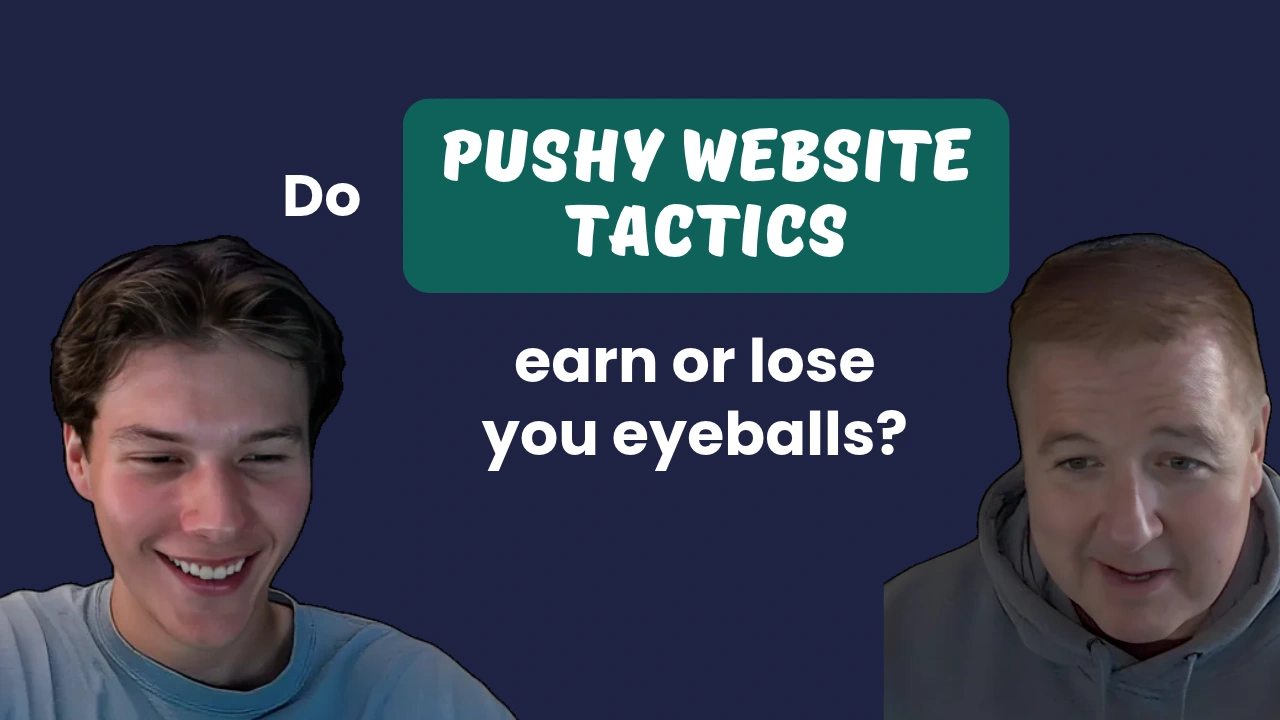
Do pushy website tactics earn or lose you eyeballs?


Show Notes
Pop-ups, subscribe walls, and chatbots that open before you have asked anything are meant to capture attention, yet hardly anyone can point to evidence that they work. Virgil and Cole ask whether these tactics earn a site its visitors or lose them, starting with where pop-ups came from and why they stick around.
Virgil explains why news sites lean on them for ad revenue and why marketers use them to shortcut a visitor’s journey, then tells the story of a sunglasses site that kept showing him the same subscribe offer and emailed him the next day even though he never gave it his address. They also take on chatbots that open with “how can I help you?” before anyone has a reason to ask, what a chatbot that actually helps would look like, and whether a bot noticing that you are struggling is useful or a little creepy. The close buttons Virgil fights with on his iPad come up too, which ties back to WCAG 2.2.
The takeaway is a different question to ask. Instead of which pop-up to put on your site, ask why, work out what people are really trying to do there, and build backwards from that.
(0:00) - Intro
(3:59) - Where pop-ups come from and why they stick around
(7:32) - The sunglasses site that emailed him anyway
(10:12) - Why the pop-up?
(15:25) - Chatbots that speak first
(19:09) - Does a chatbot noticing you struggle creep you out?
(20:08) - What to ask before you add a pop-up
(21:41) - Closing thoughts
(22:10) - Outro
Subscribe for email updates on our website:
https://www.discussingstupid.com/
Watch us on YouTube:
https://www.youtube.com/@discussingstupid
Listen on Apple Podcasts, Spotify, or Soundcloud:
https://open.spotify.com/show/0c47grVFmXk1cco63QioHp?si=87dbb37a4ca441c0
https://soundcloud.com/discussing-stupid
Check Us Out on Socials:
https://www.linkedin.com/company/discussing-stupid
https://www.instagram.com/discussingstupid/
Transcript
VIRGIL 0:00
Eyeballs, eyeballs everywhere. And everybody wants a piece. One of the most irritating things I ever see on the internet is how everybody wants to do a pop-up, some type of display, their chat jumps up in the middle and everybody wants to try and capture your attention and capture who you are right away. If you agree that this is an annoyance and a very bad user experience, or even if you don't, you should probably join us now as we start Discussing Stupid.
COLE 0:32
Discussing Stupid is brought to you by High Monkey, a digital consulting company. We talk about this stuff because we've lived it. We help organizations all over the world deal with their stupid. Find us at highmonkey.com.
VIRGIL 0:49
Hey everybody. Welcome back to the podcast. Cole, I know you kind of wondered today's subject and I want to give a little background about it and kind of explain, you know, kind of why I thought this was an important one. I'm going to put a caveat that I use my iPad religiously. Anytime that I'm not on my desktop, I'm usually on my iPad. That's where I read the news, that's where I look at everything personal and that kind of stuff. And so the issue that I see here is kind of exacerbated a lot on my iPad and on my iPhone. Maybe not as bad on a desktop, but still irritating. And ironically, it actually, when you tie it to our last episode, where we're talking about things blocking things out and that. So every site you go to these days, whether it's immediately upon arrival or I'm just scrolling down for a second and all of a sudden I get this big pop-up, sign up for X, sign up for Y, learn about X. You know, get these, all this eyeball capture. The thing is, what I find funny about it is this is not new. This is something that's been around for a long time, yet it won't go away. And I wish I could say I had a bunch of statistics on how effective this was for marketers, but I kind of feel like everybody does it just to do it. There's not really any proof that people are signing up for this stuff all the time. And it usually blocks everything. On an iPad and a phone, it blocks everything. I mean, everything else goes away. And they all do their little tricks like, well, the X doesn't show up right away. It shows up 10, 15 seconds later so that you have to read it. They do their little tricks like the X is almost the exact same color as the background of the thing. I mean, there's just so many things about it and this was marketing trickery that I think that has had its time and it's time that we look at something else. So that's why I brought up this episode because I think it's time to look at how we capture eyeballs and what's actually important.
COLE 3:14
This is almost a continuation of the mini-series we just did in some ways because a lot of how this transpires is like now by 2.2 standards. WCAG 2.2 standards.
VIRGIL 3:29
Yeah, and it's all going to be out the door, isn't it?
COLE 3:32
I mean, I hope. This is maybe one of the...
VIRGIL 3:35
Good riddance, that's all I can say. Get it out right now. Go take it off the site. I've always resisted that. I don't think in all of our years and all our different iterations of the High Monkey site, I don't think we've ever once had a pop-up.
COLE 3:49
Not while I've been here in the last five years.
VIRGIL 3:52
I don't think we ever have. I mean, I know you and I even discussed it on the discussing stupid site and we decided, nope, we don't want to pop-up there.
COLE 3:59
Yeah. So no, for sure. I think the first thing that I want to talk about in this episode is, I was curious if you know of any data that justifies the amount of pop-ups that there are on websites. Why do people keep doing them if it's just going to piss everyone off who goes on your website? Do you know the origins of pop-ups and stuff?
VIRGIL 4:31
Oh yeah, well, I mean, pop-ups have been around forever and a day. I mean, that's not really something new. When I think of the biggest abusers of this, and I do say abusers and I mean abusers, is news, and that, news articles. You know, click on an article that you find on Google and you immediately go there and as you're scrolling down, a video pops up in the corner and another one pops up in the middle of the screen and everything's about it. And it's really, it's ads, isn't it? It's ads. It's about generating ad revenue. And the logic of the news industry is it's an industry that's really struggling. So they're looking to make a dollar any way they can. And a big part of their revenue, as I understand it, is ads. But everybody else has kind of taken it upon them. Not only all these popular blog sites and everything, but then you just go to like traditional companies and it's really surprising how much they try to inject things into the conversation and understanding that you're trying to gain off their site and trying to force you down a path. Now myself, when I first got into the world of web, I did it from my background in instructional design and looking at it that in instructional design you do an outcome, you know, what is the outcome, what are you trying to get them to? And I believe in that. What are you trying to do it? The problem is that marketing has gotten there so that the end result might be that you want to get them to sign up for something or subscribe or register for an account or whatever it might be. But marketers have spent a lot of time trying to shortcut that. Otherwise why do I have to wait until they actually go through a journey that I put up when I could just throw this in front of their face, offer them a 10% discount and capture them and start spamming the crap out of them in that and also be very disruptive in that. And so I don't necessarily have stats. Maybe there are some that exist, but I couldn't find any. But probably because nobody wants to really look at this and understand that.
COLE 6:36
I think that perspective does help though, because while you might not have the specific stats, it does, I don't know, it kind of shows the maturity level that the internet has had for a while. Like, oh, why not just throw a pop-up for the user with like 25% off RV on TeamViewer, the 100% off.
VIRGIL 6:57
Yeah, well, I mean, I don't know if you saw this, but OpenAI I think it was OpenAI was the one that they actually were going to experiment with having ads inside chat prompts to be able to make more money because they're using it free. So I mean there's just this concept of that we need to do this stuff to try and you know, attract these eyeballs. I mean even going back to like, you know, Facebook pixels and you know, Google Analytics tracking and all this kind of stuff. The reality is there's so many things that we can do to try and understand our people. But in my experience, at least through my 28 plus years of doing this world is most organizations don't know what to do with it and what they do with it tends to be inefficient. I mean, I will give you a good example of that, in that even though I didn't subscribe, I was looking for a new set of sunglasses. One of the sites I went up to, I looked around a little bit and then I kept getting this pop-up. Like every two or three pages it popped up, you know, saying, subscribe and get 10% off. But they weren't the sunglasses I wanted. Okay? So I kept clicking that off and I'm like, why does this damn site not remember what I'm trying to do? This is so irritating. I'm going to leave this site. Well, you know what happened? The next day I got an email from them. I didn't give him my name, I didn't give him my email address. They used some backend digital thing to grab it because I kept interacting with that kind of stuff in there. And that to me is just invasive. It's like, oh, hey, you know, we wanted to make sure you knew this. What did I do right then? Unsubscribe. Will I ever go back to that site again? No. And I think that's part of the problem is that there's so much of what has happened with marketing that has kind of went off the rails, especially on the internet. Because, yeah, it's about driving traffic, it's about getting eyeballs, there's no disagreement about it. But it's also about doing it responsibly and not ticking people off. And that, to me, is what a lot of marketers aren't willing to look at is what they're actually doing. They're just looking for that end result. And I think there's a lot of business. I mean, we could probably go off on a big tangent about how businesses are trying to turn this stuff into more direct sales and, you know, understandable. But overall, from a fundamental web tech standpoint, this is, you know, a trend that maybe needs to go away and you need to create a better journey for people to get to these things and actually want to. Because if they really want to sign up because they find what you gave them very valuable, you have a much better chance of keeping them in.
COLE 9:59
I think the question seems to have always been, what pop-up do we put on our site? But maybe the question is why? Why the pop-up on our site?
VIRGIL 10:12
Why the pop-up?
COLE 10:13
Yeah. So I mean, along those lines, I mean, you kind of already touched on it, but what do you think are some better ways people can get people to subscribe or capture attention. This is kind of a rhetorical question said by the content guy from High Monkey, but what do you think are some better ways to go about this?
VIRGIL 10:35
There's a lot of different methods, but overall, if you want people, I mean, is that an end result or what is, I would start first by what is your purpose for that in the first place? You know, what do you want people to subscribe? So let's just, for a good example sake, let's talk about discussing stupid. Okay. Why do we want people to subscribe to our podcast? Well, we want them to subscribe to our podcast so that they listen, so that we can look at our listen numbers, and we can sit there and say we're growing, but let's be real. In the end, what do we really want to happen? We want somebody to listen, think we're really smart, and eventually come back and say, hey, you know what? I have this project. I've been listening to these guys from highmonkey that run this great podcast. They seem to know this stuff well and do that. That is the end result we eventually want. I mean, you and I both enjoy doing the podcast, but overall, that is. So if we started throwing up a pop-up all the time anytime anybody visited to subscribe there, are we getting people there because they actually think our content is great and they want to follow along? Are we throwing this up to people that randomly found us on searches and found an episode and probably clicking click out in that? So if we want somebody to stay on our site and actually explore and the first thing we do is pop-up, say subscribe and follow us and do all this kind of stuff, do you think people, just human nature with everything we're bombarded at today is more or less likely to do that?
COLE 12:12
Yeah, I think overall, I think the energy that is put towards pop-ups and stuff like that is energy that could be put elsewhere into your actual, the quality of your content. You know, I don't know, just being more present with the content that you're putting out.
VIRGIL 12:33
Yeah. So I mean, let's look at an example again, kind of just taking our podcast. So one of the things that really increased our reach, one was, you know, adding some guests, which is something we're going to do more this season. And that, we can't deny that. Two, adding the shorts, doing the YouTube shorts and the TikTok shorts and that kind of stuff, and then encouraging people to subscribe or listen right away. We've seen a definite uptick from that, that people are going to these things, you know, because those things are viewed hundreds and thousands of times versus like a typical episode, which is hundreds, you know, in that those are things that we did to be able to drive that traffic to our site. And that's exactly hits what you do. We're too busy trying to have this active thing so that we can go back to our bosses and show them, oh Look, I got 50 more subscribers. Look, I got a hundred, a thousand, you know, we're up to 10,000. But if those people aren't actually converting into something useful and they're not actually doing anything for it, then you need to think about differently. But when you talk about on a site itself, you know, I think you need to look at where you're trying to capture those eyeballs. So many sites try and capture it. The minute you hit the site, that's the first thing you see, is some kind of promo. Their thought is, well, if I give you a promo, you're more likely to stay. Well, the reality is if I know nothing about your site and I click away that promo, what happens? The promo's usually gone, right? And I don't know how to get that promo back. I don't know how to look at it there. It's something that requires my immediate attention. Now that sunglasses site that I was talking about, yeah sure, they were annoying enough to show it to me every three or four pages. So I saw it again, but overall it's right there. When would be the better time to do that? After I've actually done something deep? You know, I've went to the sunglasses site, I've actually started looking, I've started configuring some options to see what my options are in there. And then maybe as I'm clicking away from the page, you give some kind of offer there or you do that because now you've actually captured me as a person that may be actually interested in your product and you're not just trying to capture me so that you can spam me with more emails.
COLE 14:56
Yeah, so like if you are going to do a pop-up, you know, don't have it so disconnected from the rest of your content and your site to where like people, if they were interested, you know, could find it again easily. But also, like, just the invasive pop-ups, when it just deters you from interacting how you would want to interact on a site, that is some tough stuff right there.
VIRGIL 15:25
Well, and I'll tell you something even more there that I laugh at. And I know this is one of, you know, you and I have talked about how this is a pet peeve. You go to a site that has a chatbot. What's the first thing the chatbot does?
COLE 15:37
Well, talks to you. I mean, that's...
VIRGIL 15:40
It usually opens up and sits there and says, how can I help you? What can I do? And again, it's a perspective thing. And this is where I think we get this whole eyeball chasing thing really wrong. Is because they visited our site doesn't mean they're interested in anything. Doesn't mean that I want to capture them for any reason. It just means that somebody hit there. I mean, so I'll give you a quick little side example. We have a blog post on our site about Kanban boards and is our most popular blog post since it was written a long, long time ago. I think I've mentioned this in past episodes, but one of the ironic things there is people go there. We've tried different ways to get people to want to venture further in our site, but overall, nobody cares because they're not there because they need web consulting. They're there because they're interested in something that we did with OneNote and Kanban boards in that. And so you have to realize that. And so we actually stopped trying to do anything with it because it was just like, well, okay, this isn't really the audience in there. So when you go to a site and the first thing the chatbot does is open up, sit there and say, can I answer a question about such and such? Well, do I even know what such and such is? Am I even there for it? You're trying to be this proactive, really cool when as a matter of fact, I would bet if you watched like Hotjar videos or anything like that, you would probably find that most people find that stuff very annoying in that because it immediately gets in their way. And per WCAG 2.2, it gets in the way of something you're trying to do. And when you try to click it down, click it away, a lot of times it opens up fully and starts trying to have a conversation with you. And these are just, it's just poor interaction from a user perspective and causes more problems than I think it probably solves. And these are marketers trying to solve problems without having to put any effort into solving the problem, in my mind.
COLE 17:41
Yeah, you can't force people to the finish line when it comes to your website. You know, you have to, you know, have the journey to the finish line be something that's like worth going on. That's kind of what pop-ups end up kind of being, is trying to be like a shortcut to that, but you can't.
VIRGIL 18:04
Yeah, I mean an awesome chatbot would be that I go on some e-commerce site and I start searching and I search once, I search twice, I search three times. And it's smart enough to know that I can't seem to find what I'm wanting and therefore it pops up and says it seems to be you're struggling looking around here. Is there something I can help you out with? You know what, in that sense, I probably would actually get that interaction and take it and be willing because if it was a site that I actually searched on multiple times and it was because I am somewhat interested in what's there and it's probably irritating me because their search sucks and it's not helping me look for what I want and I want to just find what I want in there. Go back to my sunglasses example. It's really important that I have ones that are wide enough because I got a big fat head and I need sunglasses for a big fat head. And finding a pair of sunglasses that are for big fat heads and photochromatic so that they, you know, go light dark on their own is really hard to do.
COLE 19:09
One question though. Does any part of that whole interaction creep you out a bit when the chatbot points out that you're struggling so you're like, what are you capturing about my current activity?
VIRGIL 19:22
I mean, you're absolutely right. It's the mixed thing. I don't necessarily agree with that process of doing that, but at the same time that kind of stuff is going to become more commonplace if people are already using AI, they're already experiencing. I mean, I just asked it a prompt, you know, to Claude here just a few minutes ago and it sat there and brought up things that I had conversations with it a month ago and it's like, well, you were thinking about doing this. It's not smart enough to know that I've moved past that and I'm trying to do something else. But you know, I mean, that is from there, but that's kind of another side of, you know, kind of what you can control and what you can't in these. But I think in the end you really do have the opportunity to do it. And the big thing is really to understand what people are really trying to do on your site. What are the reasons they really Want to subscribe to something, join something in that, and then really build backwards from that and really look at that and say, is my pop-up helping that? If you have a hundred people come into your site and 95 of them subscribe to your newsletter when they hit the first page, wow, more power to you. Stop listening, go away, you're doing awesome. But if you're doing what I think probably happens, which is not true, then you need to figure out where, at what points, why is somebody subscribing at that moment or not? If nobody is, then maybe you should take that as a hint that maybe that wasn't such a swell idea.
COLE 20:54
Very kind way of putting that last point.
VIRGIL 20:56
Yeah, well, you know, it's a podcast. Probably shouldn't curse too much on it.
COLE 21:00
Yeah, we only have like a couple of times. I think both might have been me, which is odd.
VIRGIL 21:07
I think I might have a couple of times too. But let me tell you, when it comes to this thing, I swear at my iPad all the time because it gets covered up by stuff. And then I'd try to click out of something and it ends up going to the link because they made the X really small and my fingers are not small, which again, going back to WCAG 2.2, that's going to be a violation when they're not bigger from there. So, yeah, I mean, this actually does kind of fit in it. Maybe it is why I thought up the episode, because of that. But overall, I think these invasive marketing techniques just need to go away.
COLE 21:42
Indeed. iPad and tablet users out there, we see you, we hear you, and we're putting out content to hopefully raise awareness, to have better experiences.
VIRGIL 21:53
Have better experience than that. And even though we're a minority, we all appreciate it. All right, well, thank you all for joining us today. I think we had a good conversation here. Join us next time. Until then, feel free to discuss stupid on your own. If you enjoyed today's episode, you can access more by visiting us on the web at discussingstupid.com. You can also find us on LinkedIn, YouTube and TikTok and all the other major social platforms. Discussing Stupid is proudly produced and owned by High Monkey.
Latest Episodes
Do pushy website tactics earn or lose you eyeballs?
How these political party websites are failing us all

The new WCAG 2.2 rules you're already breaking (part 2)

Sign up for Discussing Stupid updates
Get the latest Discussing Stupid episodes, expert insights, and exclusive content- straight to your inbox