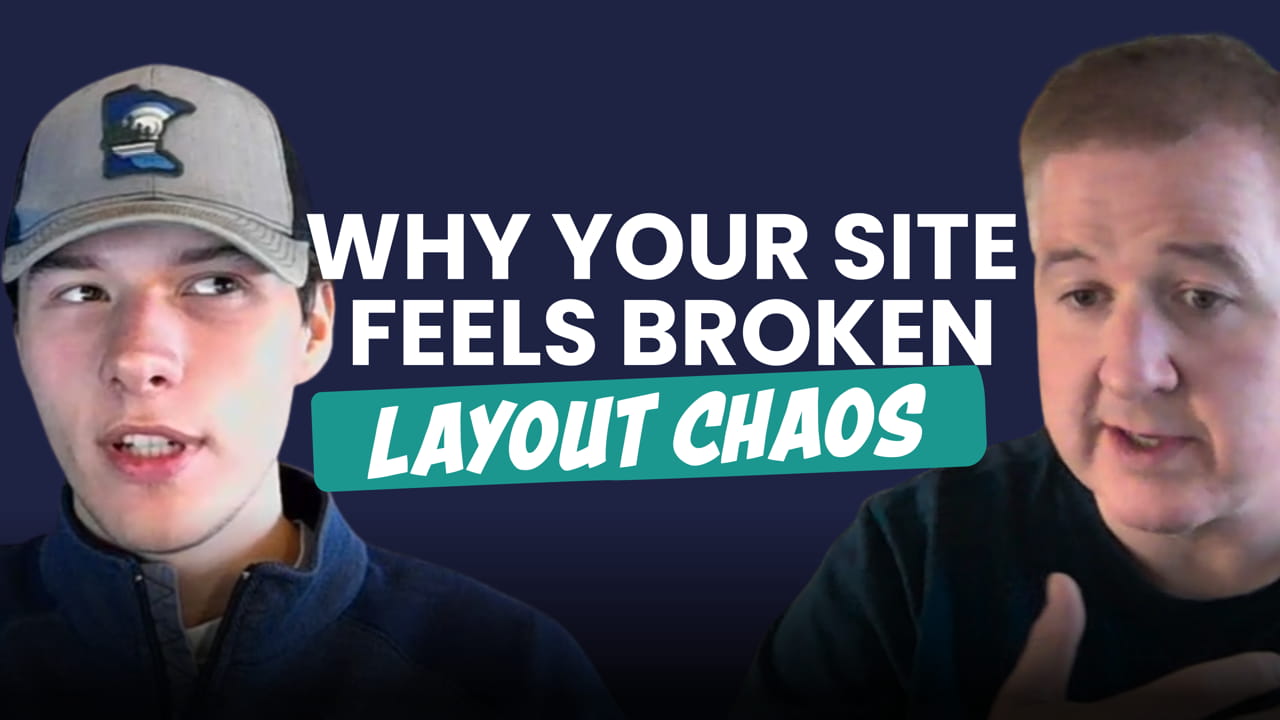
Why inconsistent layouts wreck your UX


Show Notes
In this episode of Discussing Stupid, Virgil and Cole tackle a quiet killer of user experience: layout inconsistency.
From university websites that feel like ten different brands stitched together to internal systems that change button locations with every page, inconsistent layouts confuse users, break trust, and derail digital goals. This episode dives into why it happens, what it costs, and how to start fixing it.
They also explore:
- Why inconsistent layouts are often a sign of deeper organizational problems
- How users feel bad design before they can explain it
- The difference between visual theming and layout consistency
- What a consistent structure looks like across homepage, sections, and detail pages
- Why a style guide is your most underrated asset
Whether you’re building a public-facing site or an internal portal, this episode will help you recognize the hidden ways layout chaos is holding you back—and how to clean it up.
(0:00) - Intro
(2:22) - Where layour inconsistency happens the most
(4:57) - The difference between theming and consistency
(7:24) - Structuring consistency in layers
(10:57) - Why inconsistency hurts your organization
(13:12) - Layout chaos as a symptom of deeper issues
(15:22) - How to start fixing this issue
(16:51) - Outro
Subscribe for email updates on our website:
https://www.discussingstupid.com/
Watch us on YouTube:
https://www.youtube.com/@discussingstupid
Listen on Apple Podcasts, Spotify, or Soundcloud:
https://open.spotify.com/show/0c47grVFmXk1cco63QioHp?si=87dbb37a4ca441c0
https://soundcloud.com/discussing-stupid
Check Us Out on Socials:
https://www.linkedin.com/company/discussing-stupid
https://www.instagram.com/discussingstupid/
Transcript
VIRGIL 0:06
That's one of the things that's really a problem is that people that develop sites don't always think that, well, I built it and it came out of my mind. So I know exactly how it works, but nobody else does. If they click through 10 pages of your site and across those 10 pages they have 10 different experiences that they have to learn, you're basically failing the user. You're listening to Discussing Stupid, a podcast sponsored by High Monkey. Join your host Virgil Carroll and others as our podcast helps you transform bad digital experiences into teachable moments you can use. So recently, we've been responding to a lot of requests for proposal for some website redesign. And that kind of is the inspiration for today's episode. Because every time we do that, one of the first things I like to do is I like to go to the site and I like to look at it and see what I like, what I don't like, you know, kind of what I think is there. And one of the things that happens, and I'm not going to mention the industry of the world this goes in, but I'm going to say that if you listen to the episode, you, you might just understand what one it is, is the inconsistency of layout. So when you look at things, from a user experience perspective and kind of making things easy for people to use, one of the things that we see most is that organizations, especially sites that have grown organically over time and are controlled by a lot of different content contributors and that tend to have a lot of different things. So either one uses a side nav, one uses a top nav, you know, placement of things and all that kind of stuff. And today we're going to talk about how that inconsistency of layout can cause a lot of user issues. especially when you have a lot of people controlling everything across a lot of different parts of the site. Yet from an end user experience, I'm doing one site, I'm visiting everything and how that can affect the way things go.
COLE 2:22
Quick question off the bat, like where, what type of website industry do you see this happening the most?
VIRGIL 2:30
you mean kind of what kind of organization? Yeah, those that control it themselves and don't use good people. No, I mean, I mean that is truthfully, you know, it's there. probably the place I've seen it most throughout my career are places like, especially like colleges and universities. So a lot of times their website is not a website. It's, it's, you know, different Departments, different, colleges, different. You know, that inside the organization they all control kind of their own little fiefdom, you know, inside there and they tend to do it. And you know, one interesting thing about kind of the educational market is, you know, you have kind of the government market which, you know, kind of that mentality there of kind of you can't tell me what to do, you know, which is a little bit different than commercial because commercial you tend to have people that can tell you really what to do. But then you add the education market which you tend to get, you know, what we call academic freedom. So it's like I can do whatever I want. But you know, in all the years and all the college sites I've done, probably one of the biggest things I always see is that you'll be clicking around a website and you go from you know, the, the college of you know, accounting, you know, or financial management or something like that, and then you go to the college of education and the experiences are completely different. sometimes the color scheme can even be a little bit different, but even more so you know, the experience. So you know, this one uses a left side nav, this one uses a top nav. This one, you know, has a, you know, a different looking header, the way they lay out the pages, all that kind of stuff. And I agree that's a huge thing because basically what they're causing people to do that visit their site is completely relearn their site. And that's one of the things that's really a problem is that people that develop sites don't always think that, well I built it and it came out of my mind. So I know exactly how it works, but nobody else does. So the first time somebody visits that site, they're getting a brand new experience for the very first time. And if they click through 10 pages of your site and across those 10 pages they have 10 different experiences that they have to learn. You're basically failing the user.
COLE 4:49
Yeah, I think regarding the topic again of how there's you know, completely different experience on university websites, education websites, you know, you go to like the agriculture site, the science and engineering site. Like you know, I, I think those experience, there's probably, there's probably aspects that should be different, like maybe parts of the theme like color scheme things or maybe not color scheme because I think universities tend to stick to the same one. But you should know that you're on a different site but the experience shouldn't be so drastically different that you're just so like, so confused.
VIRGIL 5:27
Yeah, One of the common things we did back in the day is, you know, you, you'd have a variation of a theme. So you, you know, a lot of colleges kind of, you know, or, or government agencies, large organizations tend to have larger color palettes. So sometimes if you had really defined areas, you'd use kind of a color association with that, in there. the other way would be like iconography, you know, iconography. I don't know why I can never say that damn word. but you know, you do use a different icon or kind of a different visual impression. So when we talk about consistent layout, we're not saying everything has to be the same. It's that the patterns have to be the same. You know, when a person jumps from one page on a site to another, there shouldn't be a. And this isn't only limited to government and academics. I mean, another thing is a lot of the animation stuff that organizations have brought in, I mean there's a long history of that in the web. But you know, one of the things I think of is like today, you know, when like, you know, people are scrolling down a site and you have parallaxic scrolling where you know, the thing kind of changes, it looks really cool and marketers really love that. But from an end user experience, it tends to be a little bit disjointed to them because they, they see this experience and they're having a hard time following the content on the page. And we've seen that through user testing and stuff that people really kind of struggle with those kind of sites. So a lot of times people do that, you know, where they're, they're trying to tell like a story, you know, ah, across a site path or something. And so they're trying to do this real uniquely. But you're never really thinking about what that experience is from the person that if the point of the story is that they actually read the content, then you should make the content front and center. Not kind of what you do around that.
COLE 7:12
Yeah, I think at the bare minimum your site or your internal system, it should be, you know, consistent. Like all the pages on it should be consistent in where like different buttons are located, like the types of like the button sizes, the fonts being used at the bare minimum. But even better, I think humans are so like pattern dependent and like they kind of expect to see across all different types of sites the same, you know, generally where information is like located and where they can expect a type of interaction to be able to take place.
VIRGIL 7:50
Yeah, I mean, you know, that's a good point is that you know, you can kind of do it a lot of different ways, but a lot of times you end up doing it by layer. So you know, the homepage is probably the page that can a lot of times have its own unique look and feel, you know, the way things lay out, the way the design is and that kind of stuff. But then when you start getting to those first level pages, you know, which are usually section pages or whatever like that, you know, you can have variability inside the page, but overall you want the structure of it. So if you are using you know, left side navigation, and then the middle is really where you have your main content and then the right side is where you're having something maybe you want to highlight or you know, you know, promote and that kind of stuff. You want to be consistent across, across all those, those kind of section landing pages that you're really looking at it from the standpoint of if I go from one to the other, it might be different content, but overall the structure of the page itself is the same. and then when you go down a layer from there, you know, like, so let's say, you know, you're in a college now, you're at a department or you're at a program, you know, or a degree or something like that. Again you'd kind of look at that of having, you know, so every degree I'd look at, again they might have different information. But overall, you know, on the right side is contact information for how I get in. In the middle is really, you know, what the program's about, you know, the, the, the, the credits needed and all that kind of stuff. And the left side is kind of some of the different things like you know, what, what type of costs are associated, you know, that kind of stuff. So you have a real consistency there. So that if I am a person that bounces around, I do that. Now part of that also goes to if you're actually paying attention to your analytics and people do that, you know, and kind of move across those spectrums. But a lot of times, you know, there's patterns where people do that and you want a consistency there so that people aren't doing it. But what we see a lot is like one degree will have the page layout this way and another one, ah, and that, so you want a consistency where you can get a little bit more flexible is when you start Getting down to kind of that third, fourth, fifth and sixth layer of pages where maybe you have some different templates about how content is really laid out for or how they do things in that there's a little bit less expectation, at least from the end user standpoint of the consistency there. But if you don't get them on a consistent path down that way, you're kind of setting yourself up for failure. And so it's probably one of the number one things when we go in and actually look at a redesign of a site or maybe an internal intranet. And that usually that's one of the things, is that people built things based off of what they thought they wanted. Never really looked at the consistency across the overall story of the site and they never really think of people visiting a site and what that overall story is. And that's really what needs to be the main priority.
COLE 10:38
Yeah, we've talked a lot about how, you know, these inconsistencies are pretty annoying and don't really lead to good user experiences. But how do these inconsistencies, you know, affect organizations or universities from like an actual business perspective? Like, how is this harming them? Why should they care about like this issue?
VIRGIL 11:01
Well, I mean, I think one thing very simply is just the attention span today is minimal to none. I mean, you think about it and if, I mean, let's just continue down the college analogy. You know, you have you know, prospective students, their parents, you know, community members, all these different people that visit your site. Well, the typical prospective student, is going to have very little patience. So if they constantly are having to figure out when they go to every page, how the page is laid out and not really focus on the content because they're just trying to figure out, well, where'd the navigation go? Where, where'd this stuff go? Why is it, why am I not seeing the contact information over here and that kind of stuff, you're already kind of setting them up for failure. So the reality is is there is definitely a pattern that's seen out there where people look at your legitimacy based off of the quality of your website. Otherwise I might be very interested in going to your educational institution or visiting your store or something. But if the website completely confuses me and I can't find that product that I'm looking for because this product looks this way and that product looks that way and that kind of, stuff overall, I'm going to be less inclined to go visit you or participate in something that you're trying to Promote or whatever it is like that. So it can affect you from a business level. It's a harder thing to gauge and to kind of understand. But overall we know for a fact that people will go there. And you know, I've done enough, kind of user interviews with prospective students, you know, and from, from high school age all the way up to, you know, senior adults. And one of the things you consistently hear is, you know, from the website, if I don't understand, if I don't feel like it's, it's fresh and that it's got good content in that, I'm just, I'm not going to even consider going there.
COLE 12:48
Yeah. Would you say that, you know, some of these issues that we're talking about with layout inconsistencies, is that kind of a symptom of a larger, deeper, organizational problem? Like.
VIRGIL 13:02
Oh, yeah, I mean, I could soapbox on that for hours. But I mean, basically a lot of times it's because there's too many cooks in the kitchen, too many people that have too many opinions and there's not enough people that want to push back on that. So a lot of times when we work on, you know, kind of global reorganizations, and you know, kind of redevelopment of a website, one of the first things you're looking at is you've got to have those sponsors, those people that are going to, you know, in the governance that goes around that people are actually going to do something about, in there. And instead of letting it, you know, I always call it the mind, mind, mind syndrome, where, you know, well, this is mine, this is mine, this is mine. I should be able to do what I want with it. And it's also the most important thing that goes on your site. And so a lot of times you have to get people on board or have somebody higher up that can say, no, it's going to be this way to make that happen. And, and that's just a reality in business. I mean, that's you know, there is no rocket science level understanding of that. It's just a reality that, that, you know, a lot of times organization do it and as a site gets launched, it grows and grows and it tends to grow organically. Somebody says, well, we need to add this. And so then they're like, oh, we saw this really cool feature and we do it this way. And that kind of stuff just really kind of develops into, more organic feeling chaos than organization.
COLE 14:30
Yeah. Real quick, if you're enjoying the episode. If you're enjoying discussing stupid, be sure to, like, subscribe and share. Help us more than, you know and... yeah!
VIRGIL 14:41
Yeah, well, we're getting towards the end of, season two. It's kind of hard to believe, that we're already here in that, so.
COLE 14:48
We are. However, I still have one more question.
VIRGIL 14:51
Yes. Okay, perfect.
COLE 14:54
So actually not like a question, but just kind of to, you know, send people off on a note of, a way they can look to improve this, this difficult, issue of inconsistent layouts across pages and whatnot. it seems like a good place to start and correct me if I'm wrong would be like, you know, establishing a design system or style guide to just keep a guideline to keep things consistent across your site. Like is. Am I, you know.
VIRGIL 15:25
Oh, you're right, you're right. I mean, you know, you could even start a step higher and kind of look at, you know, what. What are you trying to accomplish with all these differences? You know, what. What was kind of the underlying motivation for this page or this section of the site looking this way versus that way, there. But definitely, I mean, usually the first thing you have to do is you have to understand all the different layouts and all the different things that you've done and then, really look at, you know, what's effective. And this is where your, your analytics can really help. This is where kind of, doing user research can really help as far as what it is there. But first and foremost, you have to have, a style guide, which, you know, we probably look at more as a consistency guide of, like, you know, how things are going to be formatted, where they'll be located on the page, how they'll be utilized, what they're utilized for, all this kind of stuff like that.
COLE 16:17
Yeah, makes total sense. Well, thank you everyone for tuning in to this week's episode. It's been a good discussion here, and I'm sure we'll have many similar discussions in the future along the way.
VIRGIL 16:34
Yep. Thank you. Just a reminder, we'll be dropping new episodes every two weeks. If you enjoyed the discussion today, we would appreciate it if you hit the like button and leave us a review or comment below. and to listen to past episodes or be notified when future episodes are released, visit our website at www.discussingstupid.com and sign up for our email updates. Not only will we share when each new episode drops, but also we'll be including a ton of good content to help you in discussing stupid in your own organization. Of course, you can also follow us on YouTube, Apple Podcasts, Spotify, or SoundCloud, or really any of the other favorite podcast platforms you might use. Thanks again for joining and we'll see you next time.
Latest Episodes
The new WCAG 2.2 rules you're already breaking (part 2)

The new WCAG 2.2 rules you're already breaking (part 1)
Season 4: The Teaser
Sign up for Discussing Stupid updates
Get the latest Discussing Stupid episodes, expert insights, and exclusive content- straight to your inbox